Question
Write major product(s) in the following reaction .
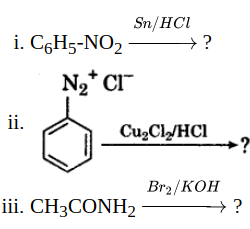
Image

Answer

Get the step-by-step solution for this question inside the Vidyadip app.

Get the answer in the app

Need a full question paper?

Generate a complete, print-ready paper with questions like this in minutes — across 16+ boards, with answer keys.

Start Generating Free

Similar questions

Concentration terms such as mass percentage, ppm, mole fraction and molality are independent of temperature, however molarity is a function of temperature. Explain.
Answer the following question:
Calculate the molality of a sulphuric acid solution in which the mole fraction of water is 0.85.
Attempt any five of the following:
$(a)$ What are Purines and Pyrimidines? Name the purines and Pyrimidines present in $\text{DNA}$ and $\text{RNA}$ nucleic Acids.
$(b)$ Write the full forms of $\text{DNA}$ and $\text{RNA}$.
$(c)$ Name the vitamin whose deficiency causes convulsions.
$(d)$ Which vitamin B group can be stored in our body?
$(e) (i)$. What is the difference between a nucleoside and nucleotide?
$(ii).$ Write one difference between a-helix and $ẞ-$pleated sheet structures of protein.
$(f)$ What are nucleic acids? Why two strands in $\text{DNA}$ are not identical but are complementary?
$(g)$ Some enzymes are named after the reaction, where they are used. What name is given to the class of enzymes which catalyse the oxidation of one substrate with simultaneous reduction of another substrate?
The following data were obtained during the first order thermal decomposition of SO2Cl2 at a constant volume.
$SO _2 Cl _2(g) \rightarrow SO _2(g)+ Cl _2(g)$
Experimenttime/s-1Total pressure/atm
100.5
21000.6
Calculate the rate of the reaction when total pressure is 0.65 atm.
Write short notes :
Acetylation
Specify the oxidation numbers of the metals in the following coordination entities:
i. $\left[ Co \left( H _2 O \right)( CN )( en )_2\right]^{2+}$
ii. $\left[ Pt ( Cl )_4\right]^{2-}$
iii. $K _3\left[ Fe ( CN )_6\right]$
iv. $\left[ Cr \left( NH _3\right)_3 Cl _3\right]$
Describe how does the enthalpy of reaction remain unchanged when a catalyst is used in the reaction.
Match the coordination compounds given in Column $I$ with the central metal atoms given in Column $II$ and assign the correct code:
 
Column $I ($Coordination Compound$)$
 
Column $II ($Central metal atom$)$
$a.$
Chlorophyll
$1.$
Rhodium
$b.$
Blood pigment
$2.$
Cobalt
$c.$
Wilkinson catalyst
$3.$
Calcium
$d.$
Vitamin $B_{12}$
$4.$
Iron
 
 
$5.$
Magnesium
Code:
(a) What is reverse osmosis? How is water purified through it? Explain.
(b) Write the applications of osmosis.
Answer the following questions.
Comment on the specificity of enzyme action. What is the most important reason for their specificity?