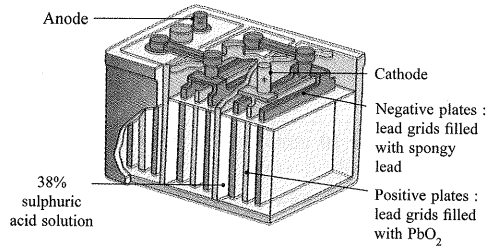
Question
Write note on lead storage cell.

Need a full question paper?

Generate a complete, print-ready paper with questions like this in minutes — across 16+ boards, with answer keys.

Start Generating Free

Similar questions

Complete the following reactions :

  1. $\text{C}_6\text{H}_5-\text{COO}^-\text{NH}^+_4\xrightarrow{\text{ }\text{ }\text{ }\text{ }\text{ }\text{ }\text{ }\text{ }\triangle\text{ }\text{ }\text{ }\text{ }\text{ }\text{ }\text{ }\text{ }\text{ }}\text{A}\xrightarrow{\text{ }\text{ }\text{ }\text{ }\text{Br}_2/\text{KOH}\text{ }\text{ }\text{ }\text{ }}\text{B}\xrightarrow{\text{ }\text{ }\text{ }\text{ }\text{CH}_3\text{COC}l_3/\text{pyridine}\text{ }\text{ }\text{ }\text{ }}\text{C}$

  2. $\text{C}_6\text{H}_5\text{N}^+_2\text{BF}^-_4\xrightarrow[\triangle]{\text{ }\text{ }\text{ }\text{ }\text{ }\text{ }\text{ }\text{ }\text{NaNO}_2/\text{Cu}\text{ }\text{ }\text{ }\text{ }\text{ }\text{ }\text{ }\text{ }\text{ }}\text{A}\xrightarrow{\text{ }\text{ }\text{ }\text{ }\text{Sn}/\text{HC}l\text{ }\text{ }\text{ }\text{ }}\text{B}\xrightarrow[\triangle]{\text{ }\text{ }\text{ }\text{ }\text{CHC}l_3+\text{alc. KOH}\text{ }\text{ }\text{ }\text{ }}\text{C}$

The decomposition of $N _2 O _5$ in $CCl _4$ solution follows the first order rate law. The concentration of $N _2 O _5$ measured at different time intervals are given ahead:
Time $(t) \sec$08016041060011301720
$\left[ N _2 O _2\right] mol /$ litre5.55.04.84.03.42.41.6

Calculate its rate constant at 410 sec and 1130 sec. What does these result show?
State the preparation, properties and uses of methanol.
Name the reagents used in the following reactions:
i. Oxidation of a primary alcohol to carboxylic acid.
ii. Oxidation of a primary alcohol to aldehyde.
iii. Bromination of phenol to 2,4,6-tribromophenol.
iv. Benzyl alcohol to benzoic acid.
v. Dehydration of propan-2-ol to propene.
vi. Butan-2-one to butan-2-ol.
(a) Out of t-butyl alcohol and n-butanol, which one will undergo acid catalysed dehydration faster and why?
(b) Carry out the following conversions :
(i) Phenol to Salicylaldehyde
(ii) t-butylchloride to t-butyl ethyl ether
(iii) Propene to Propanol
Explain the hybridisation of $\left[ Ni ( CN )_4\right]^{2-}$ complex using valance bond theory and also describes its geometry and nature.
What are alcohol, phenol and ether compounds ?
A + 2B → 3C + 2D. The rate of disappearance of B is 1 × 10⁻² mol L-1 s -1. What will be:
  1. Rate of the reaction.
  2. Rate of change in concentration of A and C?
CCl4 and water are immiscible whereas ethanol and water are miscible in all proportions. Correlate this behaviour with molecular structure of these compounds.CCl4 is a non-polar covalent compound, whereas water is a polar compound. CCl4 can neither form hydrogen bonds with water molecules nor can it break hydrogen bonds between water molecule, therefore, it is insoluble in water. Ethanol is a polar compound and can form hydrogen bonds with water, which is a polar solvent, therefore it is miscible with water in all proportions.
Calculate the equilibrium constant for the reaction.
$\begin{aligned} & Z n(s)+C u^{2+}(a q) \rightleftharpoons Z n^2(a q)+C u(s) \\ & \text { Given: } E_{Z n^{2+} / Z n}^0=-0.763 V \\ & \text { and } E_{c u^{2+} / c u}^0=+0.34 V\end{aligned}$