Question
Write note on oxides and oxoanions of 3d transition metals.

Answer

→ The ability of oxygen to stabilize the high oxidation states of metal than fluorine is higher because it forms a multiple bonds with a metal.
→ The metal oxide in lower oxidation state is basic while in higher oxidation state are acidic.
→ The metal oxides having metals in intermediate oxidation states are amphoteric.
e.g.
Acidic
oxide
Basic
oxide
Amphoteric
oxide
$Mn _2 O _7$MnO$Mn _3 O _4, Mn _2 O _3, MnO _2$
CrO$Cr _2 O _3$
Oxides of 3d Metals
Oxidati on NUmber3456789101112
+7 $Mn _2 O _7$
+6 $CrO _3$
+5 $V _2 O _5$
+4 $TiO _2$$V _2 O _4$$CrO _2$$MnO _2$
+3$Sc _2 O _3$$Ti _2 O _3$$V _2 O _3$$Cr _2 O _3$$\begin{array}{l} Mn _2 O _3 \\ Mn _3 O _4^*\end{array}$$\begin{array}{l} Fe _2 O _3 \\ Fe _3 O _4^*\end{array}$$Co _3 O _4{ }^*$
+2 TiOVO(CrO)MnOFeOCoONiOCuOZnO
+1 $Cu _2 O$
* mixed oxides
→ In the covalent oxide $Mn _2 O _7$, each Mn is tetrahedrally surrounded by O 's including a $Mn - O - Mn$ bridge. The tetrahedral $\left[ MO _4\right]^{ n -}$ ions are known for $V ^{ V }, Cr ^{ VI }, Mn ^{ V }, Mn ^{ VI }$ and $Mn ^{ VII }$.

Need a full question paper?

Generate a complete, print-ready paper with questions like this in minutes — across 16+ boards, with answer keys.
Start Generating Free

Similar questions

Calculate the degree of dissociation $(\alpha)$ of acetic acid if its molar conductivity $(\wedge_m)$ is 39.05 S cm2mol–1.
Given $\lambda^0$(H+) = 349.6 S cm2 mol–1
 $\lambda^0$(CH3COO) = 40.9 S cm2 mol–1
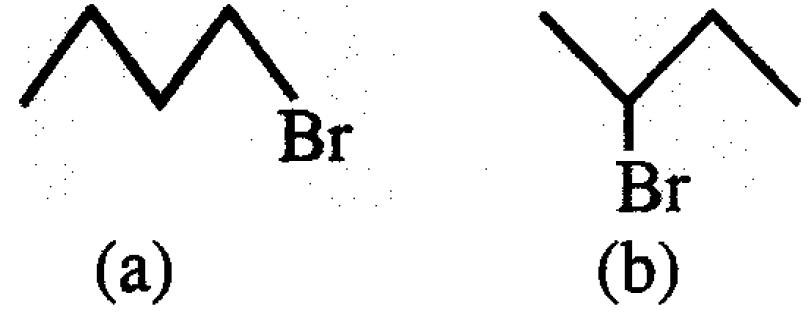
  1. Which alkyl halide from the following pair is chiral and undergoes faster SN2 reaction?

  1. Out of SN1 and SN2, which reaction occurs with
  1. Inversion of configuration.
  2. Racemisation.
Account for the following:
  1. Phenol does not react with NaHCO3 whereas carboxylic acids react.
  2. Phenol is more easily nitrated than benzene.
A compound ‘A’ is optically active. On mild oxidation, it gives a compound ‘B’ but on vigorous oxidation gives another compound ‘C’. C along with D is also formed from B by reaction with iodine and alkali. Deduce the structures of A, B, C, D.
Explain with equations, the reaction to obtain alcohols by reduction of aldehydes and ketones.
A first order reaction is 50% completed in 40 minutes at 300K and in 20 minutes at 320K. Calculate the activation energy of the reaction.
$\big(\text{Given}:\log2=0.3010,\log4=0.6021,\text{R}=8.314\ \text{JK}^{-1}\text{mol}^{-1}\big)$
Which alkyl halide from the following pairs would you expect to react more rapidly by an SN2 mechanism? Explain your answer.
$\text{CH}_3\text{CH}_2\text{CH}_2\text{CH}_2\text{Br}\ \text{or}\ \text{CH}_3\text{CH}_2\text{CH}\text{CH}_3\\\ \ \ \ \ \ \ \ \ \ \ \ \ \ \ \ \ \ \ \ \ \ \ \ \ \ \ \ \ \ \ \ \ \ \ \ \ \ \ \ \ \ \ \ \ \ \ \ \ \ \ \ \ \ \ \ \mid\\\ \ \ \ \ \ \ \ \ \ \ \ \ \ \ \ \ \ \ \ \ \ \ \ \ \ \ \ \ \ \ \ \ \ \ \ \ \ \ \ \ \ \ \ \ \ \ \ \ \ \ \ \ \ \ \text{Br}$
In a pseudo first order hydrolysis of ester in water, the following results were obtained:
t/s 0 30 60 90
[Ester]/mol L-1 0.55 0.31 0.17 0.085
  1. Calculate the average rate of reaction between the time interval 30 to 60 seconds.
  2. Calculate the pseudo first order rate constant for the hydrolysis of ester.
Give the general formula of diazonium salt. State the possible negative ions present in this salt and explain with an example how diazonium salts are named.
State Henry’s law and write its two applications.