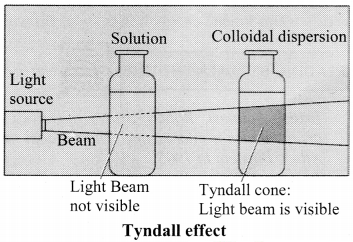
i. Tyndall observed that when light passes through true solution, the path of light through it cannot be detected.
ii. However, if the light passes through a colloidal dispersion, the particles scatter some light in all directions and the path of the light through colloidal dispersion becomes visible to observer standing at right angles to its path.
iii. The phenomenon of scattering of light by colloidal particles and making path of light visible through the dispersion is referred as Tyndall effect and the bright cone of the light is called Tyndall cone.
iv. Tyndall effect is observed only when the following conditions are satisfied.The diameter of the dispersed particles is not much smaller than the wavelength of light used.
The refractive indices of dispersed phase and dispersion medium differ largely.
v. Significance of Tyndall effect:It is useful in determining number of particles in colloidal system and their particle size.
It is used to distinguish between colloidal dispersion and true solution.