Question
Write short note: Blue Revolution.

Answer

  • Utilization of aquaculture practices for obtaining edible and commercial aquatic organisms is called blue revolution.
  • In East Asian countries where water bodies and fish population is abundant, the aquaculture was started.
  • On similar lines, in India, the aquaculture of different fresh water and marine organisms is being done with the help of fishery scientists.
  • Government of India has vowed to increase the aquaculture production by encouraging the people for aquaculture by launching the program ‘Nil- Kranti Mission-2016’ (NKM-16).
  • Pisciculutre is culturing of fish, mariculture is culture of marine organisms such as prawns/shrimps and lobsters. Sea weeds, oysters, clams are also cultured.
  • For carrying out aquaculture, 50% to 100% subsidies are offered by the Government.
  • Fresh water fishes like rohu, catla and other edible varieties like shrimp and lobsters are being cultured on a large scale which can bring about Blue Revolution.

Need a full question paper?

Generate a complete, print-ready paper with questions like this in minutes — across 16+ boards, with answer keys.
Start Generating Free

Similar questions

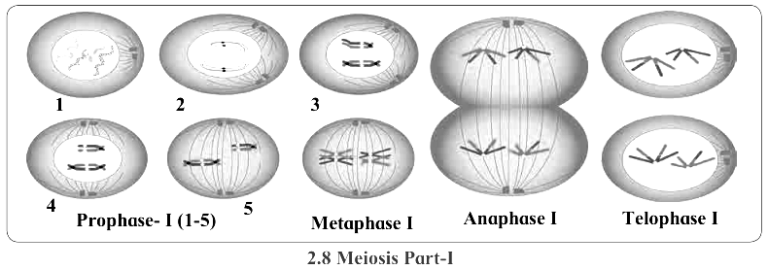
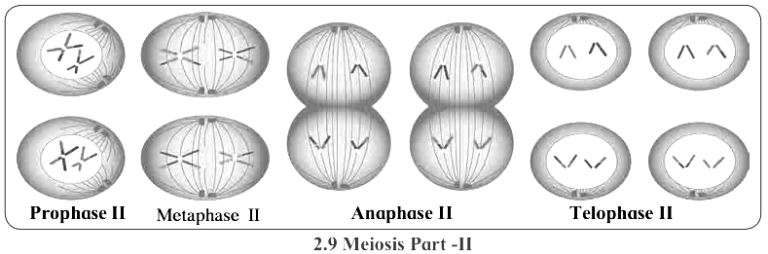
Observe the diagrams and answer the following questions.
Image
Image

(a) Which peculiarity do you observe in the figure of Metaphase-I of meiosis ?
(b) What is the important difference between Telophase-I and Telophase-II of meiosis?
(c) Which figure shows phenomena of crossing over?
There are four organisms A, B, C and D. The organism A eats only the flesh of other animals as food. The organism B can eat grains, fruits and vegetables as well as meat and fish. The organism C can make the food itself from simple inorganic substances present in the environment by utilising sunlight energy. On the other hand, organism D eats only plants and their products as food.
  1. Which organism is
  1. Omnivore,
  2. Herbivore,
  3. Carnivore?
  1. Which organism is an autotroph?
  2. Which organism is/ are heterotroph (s)?
  3. Which organism can be a producer?
  4. Which organism is/ are consumer (s)?
Give one example each of organisms which could be like A, B, C and D.
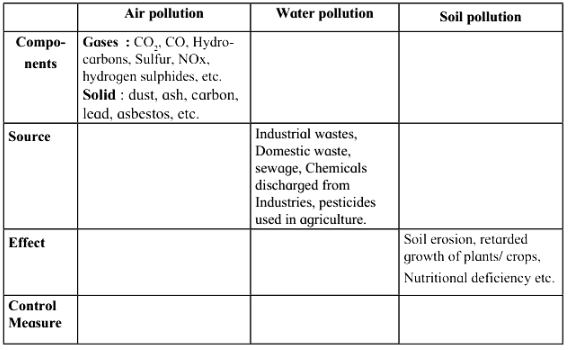
We have studied the air pollution, water pollution and soil pollution in detail in earlier classes. Based on that, complete the following chart.
Image
Answer the following questions:
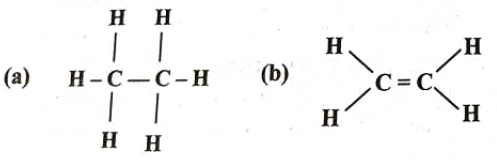
i. Identify saturated and unsaturated hydrocarbon from the given structural formula:
Image
ii. Draw electron dot structure for (a) and (b).
iii. Define Homologous series.
A thermally insulated pot has 150 g ice at temperature 0 °C. How much steam of 100 °C has to he mixed to it, so that water of temperature 50 °C will be obtained?
(Given: Latent heat of melting of ice = 80 cal/g, latent heat of vaporization of water = 540 cal/g, specific heat of water = 1 cal/g °C)
The descriptions of five kinds of images are given below:
  1. Diminished and virtual.
  2. Enlarged and real.
  3. Enlarged and erect.
  4. Real and inverted.
  5. Virtual and the same size.
Which one of these describes the image formed:
  1. On the retina of the eye?
  2. By a magnifying glass?
  3. By a convex driving mirror on a car?
  4. By a plane mirror?
  5. on the screen of a slide projector?
Write short note: Addiction.
Obtain the mathematical expression for the heat generated in a metallic conductor by electric current (Joule’s law).
Pure-bred tall pea plants are first crossed with pure-bred dwarf pea plants. The pea plants obtained in $F_1$ generation are then cross-bred to produce $F_2$ generation of pea plants.
  1. What do the plants of $F_1$ generation look like?
  2. What is the ratio of tall plants to dwarf plants in $F_2$ generation?
  3. Which type of plants were missing in $F_1$ generation but reappeared in $F_2$ generation?
How do carbohydrates, fats and proteins get digested in human beings?