Question
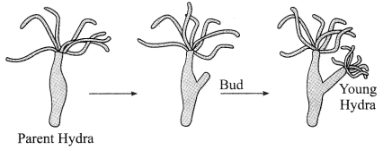
Write Short note: Budding in hydra.
Answer


Image
In multicellular organisms asexual reproduction by budding is shown by hydra. In fully grown Hydra, at specific part of its body there is development of bud.

This development is only during favourable period. The bud is an outgrowth developed due to repeated divisions of regenerative cells of body wall. It grows up gradually to form a small hydra. Parent hydra’s dermal layers and digestive cavity are in continuity with those of the budding hydra. It receives all the nutrition from parent hydra.When the budding hydra grows sufficiently, it detaches from parent hydra. Then it leads an independent life.

Need a full question paper?

Generate a complete, print-ready paper with questions like this in minutes — across 16+ boards, with answer keys.
Start Generating Free

Similar questions

Discuss the trends in the variation of metallic and nonmetallic properties In a period and in a group.
Balance the following equation stepwise.
$NaOH _{(aq)} + H_2SO_{4(aq)} \rightarrow Na_2SO_{4(aq)} +H_2O_{(l)}.$
A metal which exists as a liquid at room temperature is obtained by heating its sulphide ore in the presence of air.
  1. Name the metal and write its chemical symbol.
  2. Write the name and formula of the sulphide ore.
  3. Give the equations of chemical reactions involved in the production of metal from its sulphide ore.
  4. Name a common device in which this metal is used.
  5. Can this metal displace copper from copper sulphate solution? Why?
The transport system in plants consists of two kinds of tissues X and Y. The tissue X is made up of living cells and consists of two components A and B. The component A has tiny pores in its end walls and contains only cytoplasm but no nucleus. On the other hand, component B has cytoplasm as well as nucleus. The tissue Y is made up of dead cells and consists of two components C and D. The component C has open ends whereas component D does not have open ends. In flowering plants, either only C or both C and D transport water but D is the only water conducting tissue in non - flowering plants.
  1. What is (i) tissue X, (ii) component A and (iii) component B?
  2. What is (i) tissue Y, (ii) component C and (iii) component D?
Attempts at various levels are performed for conserving environment. Which role would you like to perform. Give two actions each:
i. Prevention
ii. Control
iii. Production
iv. Awareness
v. Conservation
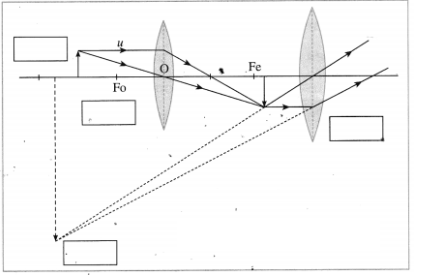
(i) Which type of microscope has the arrangement of lenses shown in the following figure?
Image
(ii) Label the figure correctly.
(iii) Write the working of this microscope.
(iv) Where is this microscope used?
(v) Suggest a way to increase the efficiency of this microscope.
An object placed 4cm in front of a converging lens produces a real image 12cm from the lens.
  1. What is the magnification of the image?
  2. What is the focal length of the lens?
  3. Draw a ray diagram to show the formation of image. Mark clearly F and 2F in the diagram.
Explain with an example, how genes control the characteristics (or traits).
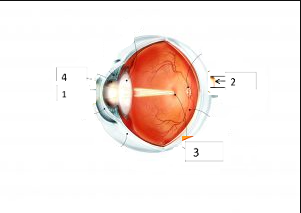
Write the function of the human eye and label parts of the figure given below.

Image
What is myopia or nearsightedness? What are the possible reasons of myopia? How is myopia corrected? Explain with diagrams.