Question
Write short notes :
Ammonolysis

Answer

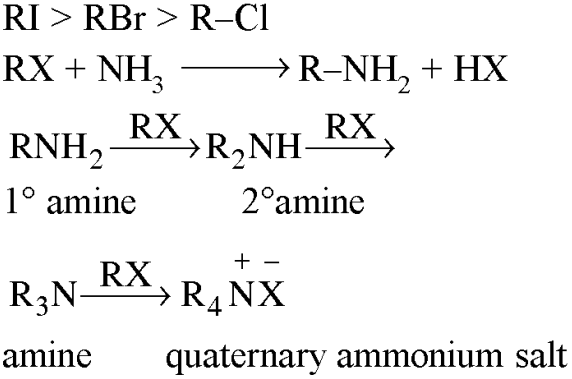
Ammonolysis : An alkyl or benzyl halide on reaction with an ethanoic solution of ammonia under goes nucleophilic substitution reaction in which the halogen atom is replaced by an ammino $\left(- NH _2\right)$ group. This process of cleavage of the $C - X$ bond by ammonia molecule is known as ammonolysis the reaction is carried out in sealed tube at 373 K . The primary amine thus obtained can further react with alkyl halide to form secondary and tertiary amines and finally quaternary ammonium salt. So here mixture of compounds is formed. For this reaction order of reactivity of alkyl halides is as follows :
Image
Amine obtained from reaction reacts with HX and forms salt. Which is treated with strong base and again amine is obtained.
Image
(i) By this reaction to obtain primary amine as main product ammonia should be taken in excess.
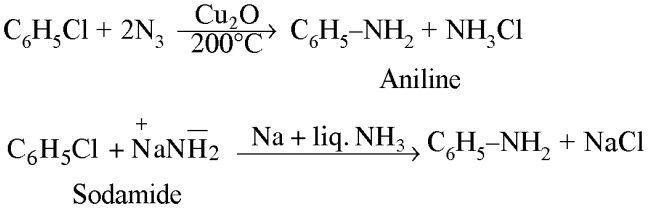
(ii) By this reaction for motion of aniline is difficult because due to + M effect in chlorobenzene and carbonchlorine bond attains double bond character so reactivity of this is decreases. So formation of aniline is performed by following specific methods :
Image

Need a full question paper?

Generate a complete, print-ready paper with questions like this in minutes — across 16+ boards, with answer keys.

Start Generating Free

Similar questions

Assign reasons for the following:
  1. The enthalpies of atomisation of transition elements are high.
  2. The transition metals and many of their compounds act as good catalyst.
  3. From element to element the actinoid contraction is greater than the lanthanoid contraction.
  4. The $E^0$ value for the $Mn^{3+}/Mn^{2+}$ couple is much more positive than that for $Cr^{3+}/Cr^{2+}.$
  5. Scandium $(Z = 21)$ does not exhibit variable oxidation states and yet it is regarded as a transition element.
Explain the following reactions of phenol :
(i) Nitration
(ii) Gatterman aldehyde synthesis
(iii) Fries rearrangement
(iv) Reaction with mercuric acetate.
Mention the type of compounds formed when small atoms like H, C and N get trapped inside the crystal lattice of transition metals. Also give physical and chemical characteristics of these compounds.
Which of the following compounds would undergo aldol condensation, which the Cannizzaro reaction and which neither? Write the structures of the expected products of aldol condensation and Cannizzaro reaction.
  1. Methanal
  2. 2-Methylpentanal
  3. Benzaldehyde
  4. Benzophenone
  5. Cyclohexanone
  6. 1-Phenylpropanone
  7. Phenylacetaldehyde
  8. Butan-1-ol
  9. 2,2-Dimethylbutanal.
The time required for $10\%$ completion of a first order reaction at $298K$ is equal to that required for its $25\%$ completion at $308K.$ If the value of $ A$ is $4 \times 10^{10}s^{–1}.$ Calculate $k$ at $318K$ and $E_a.$
Write the Nernst equation and emf of the following cells at 298 K :
(i) $Mg ( s )\left| Mg ^{2+}(0.001 M )|| Cu ^{2+}(0.0001 M )\right| Cu ( s )$
(ii) $Fe ( s )\left| Fe ^{2+}(0.001 M )|| H ^{+}(1 M )\right| H _2(g)(1 bar ) \mid Pt ( s )$
(iii) $Sn ( s )\left| Sn ^{2+}(0.050 M )||H ^{+}(0.020 M )\right| H _2(g)(1 bar ) \mid Pt ( s )$
(iv) $\operatorname{Pt}( s )|\overline{\operatorname{B}}r(0.010 M )|Br _{2(l)}||H ^{+}(0.030 M )|$ $H _2(g)(1 bar ) \mid Pt ( s )$.
Explain the following :
(i) Fermentation
(ii) Dehydration
(iii) Hydrogen bonding in alcohols.
Explain the various methods of preparation of $CHCl _3$ and its chemical properties.
Rate constant for a first order reaction has been found to be $2.54 \times 10^{-3}s^{-1}.$ Calculate its three$-$fourth life.
Describe the structure of CsCl.