Question
Write short notes :
Hope's apparatus

Answer


Image
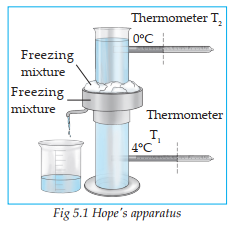
(i) The anomalous behavior of water can be studied with Hope's apparatus.
(ii) In Hope's apparatus, there is a metallic cylindrical container. At the middle of the cylinder, there is a flat bowl.
(iii) Two thermometer one at the upper region and other at the lower region is fixed to record the temperature.
(iv) The freezing mixture of salt and ice is taken in the flat bowl. Temperatures are recorded after every 30 min.
(v) Water of 10°C is poured into the cylindrical container. Initially, both the thermometers show the temperature of 10°C.
(vi) As the temperature of water decreases due to freezing mixture, it contracts, density increases and goes to the bottom of the container till 4°C.
(vii) Due to this, for sometime the thermometer at the bottom shows temperature of 4°C.
(viii) As the temperature falls below 4°C water in the region expands instead of contracting, density decreases and this water rises towards the surface.
(ix) After sometime, the upper thermometer shows the temperature of 0°C and the lower
thermometer shows 4°C.
(x) Finally both thermometer show 0°C
(xi) In this way, the anomalous behaviour of water can be demonstrated in the laboratory by using Hope's apparatus.
Need a full question paper?

Generate a complete, print-ready paper with questions like this in minutes — across 16+ boards, with answer keys.

Start Generating Free

Similar questions

Show with the help of diagrams, how you would connect three resistors each of resistance $6 Ω,$ so that the combination has resistance of
  1. $9 Ω$
  2. $ 4 Ω.$
Write short notes on the following: Tinning.
An organism A which cannot move from one place to another, makes a simple food B from the substances C and D available in the environment. This food is made in the presence of a green coloured substance E present in organs F in the presence of light energy in a process called G. Some of the simple food B also gets converted into a complex food H for storage purposes. The food H gives a blue-black colour with dilute iodine solution.
  1. What is (i) organism A, (ii) food B and (iii) food H?
  2. What are C and D?
  3. Name (i) green coloured substance E, and (ii) organ F.
  4. What is the process G?
A and B are two pairs of glands that are present in the human endocrine system. The pair A is found only in females, whereas B is present only in males. Glands A make and secrete two hormones C and D, whereas glands B make and secrete only one hormone E. In addition to hormones, Glands A make gametes F, whereas glands B make gametes G.
  1. What are the glands A?
  2. What are the hormones C and D?
  3. What are the glands B? Name the hormone E.
  4. What are the gametes F and G?
  5. Which event in the life of males and females is associated with the secretion of the hormones C, D and E?
Image
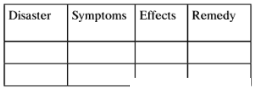
Write short note: Pre-disaster management.
When a person eats sugary food, then organisms A present in his mouth act on sugar to produce a substance B. The substance B first dissolves the calcium salts from the top part C of the tooth and then from its middle part D forming holes E. These holes ultimately reach the part F in the lower part of tooth which contains nerves and blood vessels. The substance B irritates the nerve endings inside the tooth causing toothache.
  1. What are (i) organisms A, and (ii) substance B?
  2. What are (i) part C, and (ii) part D, of tooth known as?
  3. By what name are the holes E in the tooth known?
  4. Name the part F of the tooth.
  5. What will happen if organisms A reach part F of the tooth known?
Make a chart which shows the name of the element, valency, atomic number, electronic configuration in the 2nd row of the modern periodic table and arrange these elements in ascending order of atomic mass.
What is meant by homologous series?
When a black metal compound $XO$ is heated with a colourless gas $Y_2,$ then metal $X$ and another compound $Y_2O$ are formed. Metal $X$ is red-brown in colour which does not react with dilute acids at all. Gas $Y_2$ can be prepared by the action of a dilute acid on any active metal. The compound $Y_2O$ is a liquid at room temperature which can turn anhydrous copper sulphate blue.
  1. What do you think is metal $X?$
  2. What could be gas $Y_2?$
  3. What is compound $XO?$
  4. What is compound $Y_2O?$
  5. Write the chemical equation of the reaction which takes place on heating $XO$ with $Y_2.$
  6. What type of chemical reaction is illustrated in the above equation?