Question
Write short notes on:
Tuberculosis.

Answer

Tuberculosis: T.B. is an infectious disease which is communicated from one person to another directly or indirectly. It is caused by the bacterium called Mycobacterium tuberculosis. T.B. can affect all parts of the body such as lungs, lymph glands, bones, intestine etc. The incubation period of T.B. includes a few weeks to a few years. The patient of tuberculosis feels sick and weak. There is a loss of appetite and weight. Typical fever pattern and night sweats are also common.

Need a full question paper?

Generate a complete, print-ready paper with questions like this in minutes — across 16+ boards, with answer keys.
Start Generating Free

Similar questions

When $5\ g$ of calcium is burnt in $2\ g$ of oxygen, then $7\ g$ of calcium oxide is produced. What mass of calcium oxide will be produced when $5\ g$ of calcium is burnt in $20\ g$ of oxygen? Which law of chemical combination will govern your answer?
Define the term hybridization and photoperiod.
Calcium chloride when dissolved in water dissociates into its ions according to the following equation.
$CaCl_2(og) \rightarrow Ca^{2+} (aq) + 2Cl-{(aq)}$
Calculate the number of ions obtained from $CaCl_2$ when $222\ g$ of it is dissolved in water.
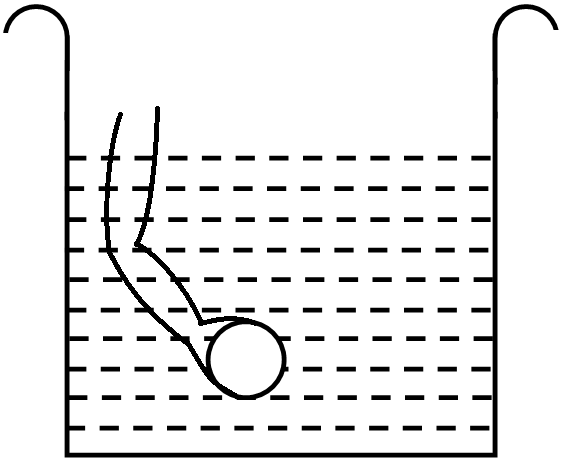
A hollow plastic ball is taken to the bottom of a trough of water and released there (see adjoining figure).
  1. What happens to the ball?
  2. Give reason for this phenomenon.
Give one point of difference between notochord and nerve cord.
What are meristematic tissues? Explain with the help of suitable diagram. Give their classification on the basis of their position in the plant body.
Define intercropping. How does it differ with mixed cropping?
Name the various types of fisheries. Write a note on culture fishery.
$i$. Sound is produced when your school bell is struck with a hammer. Why?
$ii.$ A powerful sound signal sent from a ship is received again after $4.8$ seconds. How deep is the ocean bottom? $($Speed of sound in water $= 1500 m/s).$

Given alongside is the velocity-tine graph for a moving body:
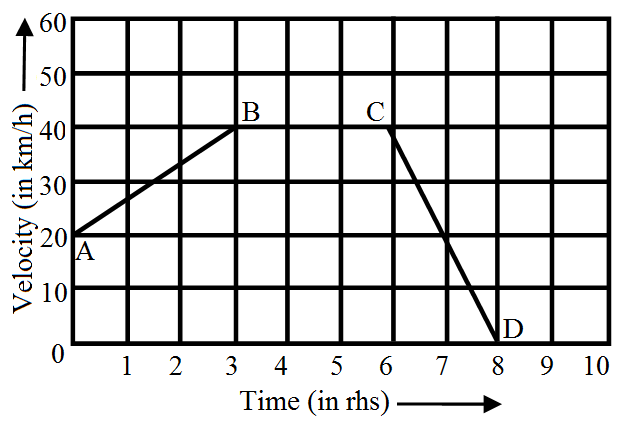

Find:

  1. Velocity of the body at point C.
  2. Acceleration acting on the body between A and B.
  3. Acceleration acting on the body between B and C.