Question
Write Snell's law and derive its general equation.

Answer

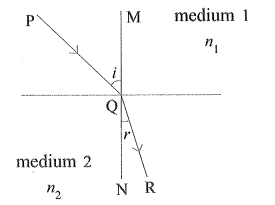
$\rightarrow $ ​​​​​​​Snell's Law : For a given two medium the ratio of the sine of the angle of incidence to the sine of angle of refraction is constant.
$\frac{\sin i}{\sin r}=n_{21}......(1)$
where, $n_{21}$ is the refractive index of the second medium with respect to the first medium.
Image
$\rightarrow $ absolute refractive index of medium $(1),$
$n_1=\frac{C}{v_1}$
absolute refractive index of medium $ (2),$
$n_2=\frac{ C }{ v _2}$
(where, C is the velocity of light in vacuum.)
$\therefore n_{21}=\frac{v_1}{v_2} \text { and } \frac{n_2}{n_1}=\frac{v_1}{v_2}$
$\therefore n_{21}=\frac{n_2}{n_1}......(2)$
$\rightarrow $ From equation $(1)$ and equation $(2),$
$\therefore \frac{\sin i}{\sin r}=\frac{n_2}{n_1}$
$\therefore n_1 \sin i=n_2 \sin r$
$\rightarrow $ This is called the general equation of Snell's law.

Need a full question paper?

Generate a complete, print-ready paper with questions like this in minutes — across 16+ boards, with answer keys.
Start Generating Free

Similar questions

A tightly closed metal lid of a glass bottle can be opened more easily if it is put in hot water for some time. Explain.
Establish the relationship between the intensity $\overrightarrow{ E }$ of the electric field and the electric potential V.
Balmer series was observed and analysed before the other series. Can you suggest a reason for such an order?
The length and the radius of a cylinder measured with a slide callipers are found to be 4.54cm and 1.75cm respectively. Calculate the volume of the cylinder.
A parallel plate capacitor with air between the plates has a capacitance of 8 pF. The separation between the plates is now reduced by half and the space between them is filled with a medium of dielectric constant 5. Calculate the value 
of capacitance of the capacitor in the second case.
Determine the distance of closest approach when an alpha particle of kinetic energy 4·5 MeV strikes a nucleus of Z = 80, stops and reverses its direction.
In which direction would a compass needle align if taken to geographic (i) north pole and (ii) south pole?
The following figure shows the variation of intensity of magnetisation versus the applied magnetic field intensity, H, for two magnetic materials A and B:
  1. Identify the materials A and B.
  2. Why does the material B, have a larger susceptibility than A, for a given field at constant temperature?
A long straight wire carrying a current of $30 A$ is placed in an external uniform magnetic field of $4.0 \times 10^{-4} T$ parallel to the current. Find the magnitude of the resultant magnetic field at a point $2.0 \ cm$ away from the wire.
The susceptibility of magnesium at $300K$ is $1.2 \times 10^{-5}.$ At what temperature will the susceptibility increase to $1.8 \times 10^{-5}?$