Question
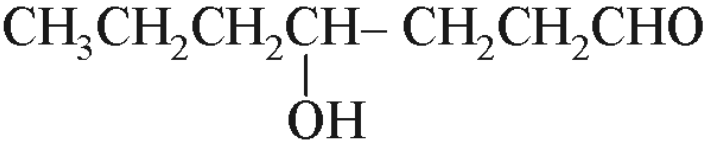
Write structural formulas and names of four possible aldol condensation products from propanal and butanal in each case indicate which aldehyde acts as nucleophile and which as electrophile.


Answer

Four products obtained by the aldol condensation of propanal and butanal are as follows :
(i) Product formed from propanal 
Image
(ii) Product formed from butanal
Image
(iii) Product formed when propanal as nucleophile and butanal as electrophile
Image
(iv) Product formed when butanal as nucleophile and propanal as electrophile
Image

Need a full question paper?

Generate a complete, print-ready paper with questions like this in minutes — across 16+ boards, with answer keys.

Start Generating Free

Similar questions

  1. What is a ligand? Give an example of a bidentate ligand.
  2. Explain as to how the two complexes of nickel, $[Ni(CN)_4]^{2–}$ and $Ni(CO)_4$, have different structures but do not differ in their magnetic behaviour. $(Ni = 28).$
The molar conductivity of $0.025 mol L^{–1}$ methanoic acid is $46.1 S \ cm^2 mol^{–1}.$ Calculate its degree of dissociation and dissociation constant. Given $\lambda ^0 (H^+) = 349.6 S \ cm^2 mol^{–1}$ and $\lambda ^0 (HCOO^–) = 54.6 S \ cm^2 mol^{-1}.$
Give equations of the following reactions:
$i.$ Oxidation of propan$-1-ol$ with alkaline $KMnO_4$ solution.
$ii.$ Bromine in $CS_2$ with phenol.
$iii.$ Dilute $HNO_3$ with phenol.
$iv.$ Treating phenol with chloroform in presence of aqueous $NaOH.$
Explain with examples the terms weak and strong electrolytes.
Write the following reaction :
(i) Carbylamine reaction
(ii) Diazotization reaction
(iii) Hoffmann bromamide reaction
Describe the oxidising action of potassium dichromate and write the ionic equation for its reaction with : 
(i) Iodide, (ii) Iron, (II) solution and (iii) H2S
Calculate the standard cell potentials of galvanic cell in which the following reactions take place:
$2Cr(s) + 3Cd^{2+}(aq) \rightarrow 2Cr^{3+}(aq) + 3Cd$
Calculate the $\triangle_\text{r}\text{G}^\ominus$ and equilibrium constant of the reactions.
$a.$ Write the formulation for the galvanic cell in which the reaction $\ce{Cu(s) + 2Ag^{+}(aq) \rightarrow Cu^{2+}(a q) + 2Ag(s)}$ takes place.
Identify the cathode and the anode reactions in it.
$b.$ Write Nernst equation and calculate the emf of the following cell: $Sn ( s )\left| Sn ^{2+}(0.04 M ) \| H ^{+}(0.02 M )\right| H _2(g) \mid \operatorname{Pt}( s )$
$\left(\right.$ Given $\left.\ce{E_{S n^{2+} / S n}}=-0.14 V\right)$
What is the secondary structure of proteins?
Account for the following :
(i) The order of reactivity of halogen acids towards alcohols is : $\quad HI > HBr > HCl$
(ii) The order of acidity of alcohols falls in the order : primary > secondary > tertiary.
(iii) The - OH group in phenols is ortho- and para-directing.