Question
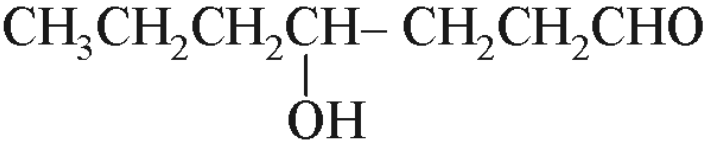
Write structural formulas and names of four possible aldol condensation products from propanal and butanal in each case indicate which aldehyde acts as nucleophile and which as electrophile.


Answer

Four products obtained by the aldol condensation of propanal and butanal are as follows :
(i) Product formed from propanal 
Image
(ii) Product formed from butanal
Image
(iii) Product formed when propanal as nucleophile and butanal as electrophile
Image
(iv) Product formed when butanal as nucleophile and propanal as electrophile
Image

Need a full question paper?

Generate a complete, print-ready paper with questions like this in minutes — across 16+ boards, with answer keys.

Start Generating Free

Similar questions

Explain the following:
Haloalkanes react with KCN to form alkyl cyanides as main product while AgCN forms isocyanides as the major product.
Account for the following:
  1. Electrophilic substitution in case of aromatic amines takes place more readily than benzene.
  2. CH3CONH2 is a weaker base than CH3CH2NH2.
  3. Nitro compounds have higher boiling points than hydrocarbons having almost same molecular mass.
How many mL of 0.1 M HCl are required to react completely with 1 g mixture of Na2CO3 and NaHCO3 containing equimolar amounts of both?
Give the reasons for following:
(i) $E ^{\circ}$ value for $\left( mn ^{+2} / mn \right)$ is negative whoreas for $\left( cn ^{2+} / cu \right)$ is positive.
(ii) Actinoids show irregularities in their electronic configuration.
The rate for the reaction R→P is rate = k[R]. It has been shown graphically below. What is rate constant for the reaction?

Boiling point of water at 750 mm Hg is 99.63°C. How much sucrose is to be added to 500 g of water such that it boils at 100°C.
Why Haloarenes undergo electrophilic substitution reactions at o and p - position? Why it is less reactive than benzene ?
An aromatic compound ‘A’ on heating with Br2 and KOH forms a compound ‘B’ of molecular formula C6H7N which on reacting with CHCl3 and alcoholic KOH produces a foul smelling compound ‘C’. Write the structures and IUPAC names of compounds A, B and C.
How would you account for the following:
E° of Cu is +0.34 V while that of Zn is -0.76 V.
A copper-silver cell is set up. The copper ion concentration in it is 0.10 M. The concentration of silver ion is not known. The cell potential measured 0.422 V. Determine the concentration of silver ion in the cell.
$\text{Given: E}^{o}_{\text{Ag}^{+}/\text{Ag}}=+0.80\text{V},\text{E}^{o}_{\text{Cu}^{2+}/\text{Cu}}=+0.34\text{V}.$