Question
  1. Write symbolically the β decay process of$\frac{15}{32}$P.
  2. Derive an expression for the average life of a radionuclide. Give its relationship with the half-life.

Answer

β decay process
$^{32}_{15}\text{P}\rightarrow^{32}_{16}\text{S} + \text{e}^{-} + \overline{\text{v}}\text{ or }^{32}_{15}\text{P}\rightarrow^{32}_{15}\text{X} + _{-1}\text{e}^{0} + \overline{\text{v}}$
Derivation of average life:
$\tau=\frac{\lambda\text{N}_{0}\int\limits_{0}^{\infty}\text{te}^{-\lambda\text{t}}\text{dt}}{\text{N}_{0}} = \lambda\int\limits_{0}^{\infty}\text{te}^{-\lambda\text{t}}\text{dt}$
$\Rightarrow\tau = 1/ \lambda$
Relation of average life with half life:
$\text{T}_{1/2} = \frac{\ell\text{n}2}{\lambda} = \tau\ell\text{n} 2$

Need a full question paper?

Generate a complete, print-ready paper with questions like this in minutes — across 16+ boards, with answer keys.
Start Generating Free

Similar questions

Theory of relativity reveals that mass can be converted into energy. The energy E so obtained is proportional to certain powers of mass m and the speed c of light. Guess a relation among the quantities using the method of dimensions.
How are em waves produced by oscillating charges? Draw a sketch of linearly polarised em waves propagating in the Z-direction. Indicate the directions of the oscillating electric and magnetic fields.
Find the ratio of the lengths of an iron rod and an aluminium rod for which the difference in the lengths is independent of temperature. Coefficients of linear expansion of iron and aluminium are 12 × 10-6 °C-1 and 23 × 10-6 °C-1 respectively.
The work function of a metal is 2.5 x 10 -19J.
  1. Find the threshold frequency for photoelectric emission.
  2. If the metal is exposed to a light beam of frequency 6.0 x 10⁻¹⁴ Hz, what will be the stopping potential?
“Gauss’s law in electrostatics is true for any closed surface, no matter what its shape or size is”. Justify this statement with the help of a suitable example.
Explain the effect of frequency of incident radiation on stopping potential.
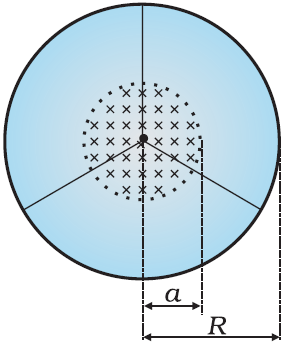
A line charge $\lambda$ per unit length is lodged uniformly onto the rim of a wheel of mass M and radius R. The wheel has light non-conducting spokes and is free to rotate without friction about its axis (Fig.). A uniform magnetic field extends over a circular region within the rim. It is given by,
B = – B0k (r ≤ a; a < R)
= 0 (otherwise)
What is the angular velocity of the wheel after the field is suddenly switched off?

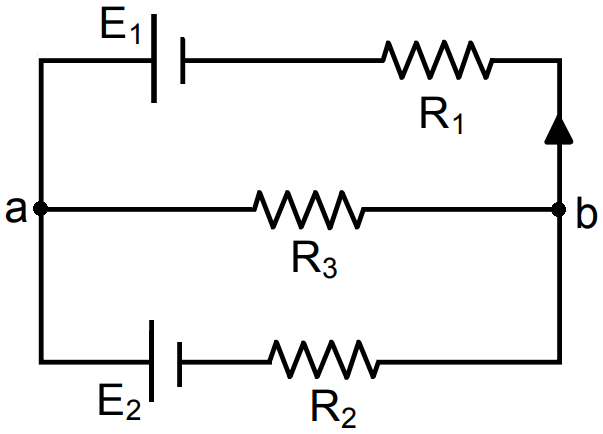
Find the potential difference Va - Vb in the circuits shown in figure.


A car moves with a speed of 54km/h towards a cliff. The horn of the car emits sound of frequency 400Hz at a speed of 3.35m/s.
  1. Find the wavelength of the sound emitted by the horn in front of the car.
  2. Find the wavelength of the wave reflected from the cliff.
  3. What frequency does a person sitting in the car hear for the reflected sound wave?
  4. How many beats does he hear in 10 seconds between the sound coming directly from the horn and that coming after the reflection?
Why is it not possible to make permanent magnets from paramagnetic materials?