Question
Write the boundary conditions of dimensional equations.

Answer

self

Need a full question paper?

Generate a complete, print-ready paper with questions like this in minutes — across 16+ boards, with answer keys.
Start Generating Free

Similar questions

Find the expression of the position of the center of mass of a system of n-particles.
State the assumptions of the kinetic theory of gases. The density of carbon dioxide gas at $0^{\circ} \mathrm{C}$ and at a pressure of $1.0 \times 10^5$ newton/ metre ${ }^2$ is $1.98 \mathrm{~kg} / \mathrm{m}^3$. Find the root mean square velocity of its molecules at $0^{\circ} \mathrm{C}$ and $30^{\circ} \mathrm{C}$. Pressure is constant.
Define the term orbital speed. Establish a relation for orbital speed of a satellite orbiting very close to the surface of the earth. Find the ratio of this orbital speed and escape speed.
  1. What is an adiabatic process? Derive expression for the work done during such process.
  2. A refrigerator is to maintain eatable kept inside at $9^\circ C$. If the room temperature is $36^\circ C$. Calculate the co-efficient of performance.
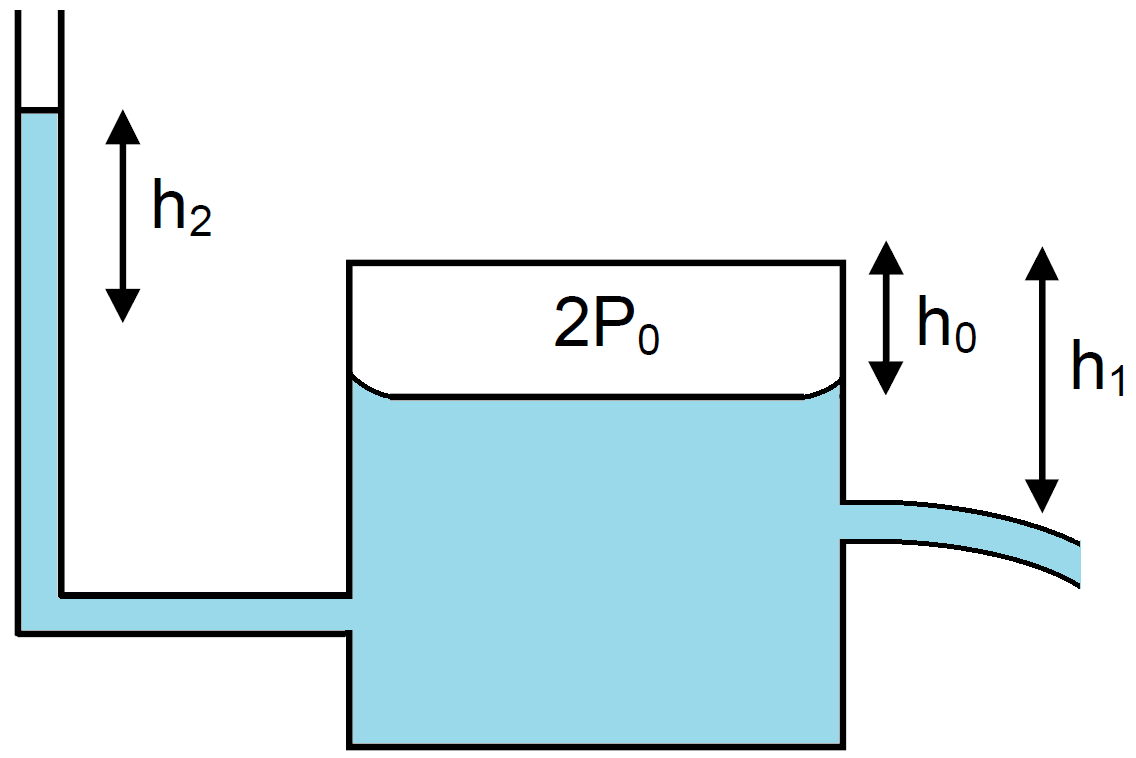
Figure. shows a large closed cylindrical tank containing water. Initially the air trapped above the water surface has a height $h_0$ and pressure $2p_0$ where $p_0$ is the atmospheric pressure. There is a hole in the wall of the tank at a depth $h_1$ below the top from which water comes out. A long vertical tube is connected as shown.
  1. Find the height $h_2$ of the water in the long tube above the top initially.
  2. Find the speed with which water comes out of the hole.
  3. Find the height of the water in the long tube above the top when the water stops coming out of the hole.
Consider that an ideal gas ( $n$ moles) is expanding in a process given by $P=f(V)$, which passes through a point $\left(V_0\right.$ $\left.P_0\right)$. Show that the gas is absorbing heat at $\left(P_0, V_0\right)$ if the slope of the curve $P=f(V)$ is larger than the slope of the adiabat passing through $\left(\mathrm{P}_0, \mathrm{~V}_0\right)$.
Two objects of masses $m_1$ and $m_2$ are moving with velocities $u_1$ and $u_2$ respectively collide in an inelastic collision. If after the collision both the objects move together then calculate the change in the value of energy
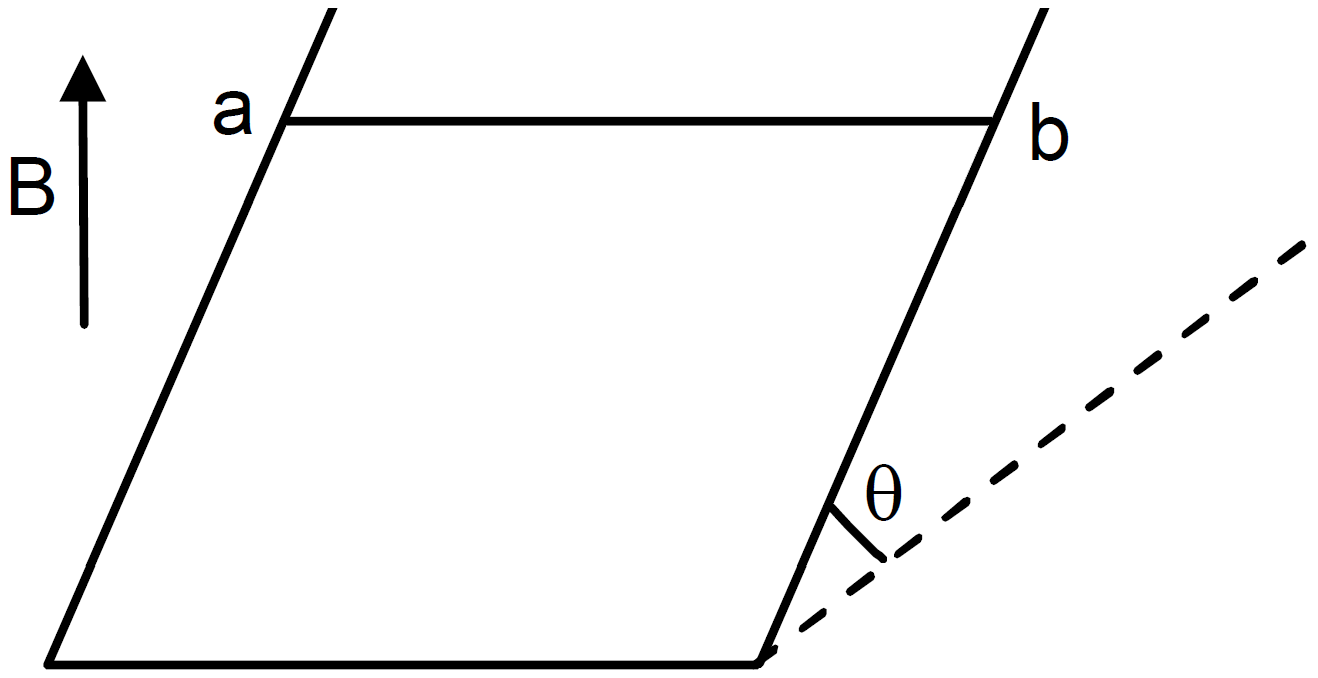
A wire ab of length l, mass m and resistance R slides on a smooth, thick pair of metallic rails joined at the bottom as shown in figure. The plane of the rails makes an angle θ with the horizontal. A vertical magnetic field B exists in the region. If the wire slides on the rails at a constant speed v, show that$\text{B}=\sqrt{\frac{\text{mgR}\sin\theta}{\text{vl}^2\cos^2\theta}}$
An isolated particle of mass m is moving in a horizontal plane (x - y), along the x-axis at a certain height about the ground. It explodes suddenly into two fragments of masses $\frac{\text{m}}{4}$ and $3\frac{\text{m}}{4}.$ An instant later, the smaller fragment is at y = + 15 cm. What is the position of larger fragment at this instant?
Three point masses m,, m, and m, are located at the vertices of an equilateral triangle of side length a. What is the moment of inertia about an axis along the altitude of the triangle passing through $m_1$?