Question
Write the centripetal force formula for an electron moving in a stationary orbit in a hydrogen atom and derive the formula for the radius of the orbit.

Answer

Form Rutherford's nuclear model of the atom, it can be said that atom is an electrically neutral sphere consisting of a very small, massive and positively charged nucleus at the centre surrounded by the revolving electrons in their respective dynamically stable orbits.
The electrostatic force of attraction $F _{ e }$ between the revolving electrons and the nucleus provides the required a centripetal force $F _{ c }$ to keep them in their orbits.
Thus, for a dynamically stable orbit in a hydrogen atom,
$F _{ e }= F _{ c }$
$\begin{aligned}
\therefore \quad \frac{1}{4 \pi \varepsilon_0} \cdot \frac{e^2}{r^2} & =\frac{m v^2}{r} \\
\therefore \quad \frac{1}{4 \pi \varepsilon_0} \cdot \frac{e^2}{r} & =m v^2 \\
\therefore \quad r & =\frac{e^2}{4 \pi \varepsilon_0 m v^2} \\
& \text { OR } \\
\therefore \quad v^2 & =\frac{e^2}{4 \pi \varepsilon_0 m r} \\
\therefore & =\sqrt{\frac{e^2}{4 \pi \varepsilon_0 m r}}
\end{aligned}$

Need a full question paper?

Generate a complete, print-ready paper with questions like this in minutes — across 16+ boards, with answer keys.
Start Generating Free

Similar questions

Which rules are followed in nuclear reactions?
The light emitted in the transition n = 3 to n = 2 in hydrogen is called $\text{H}_\alpha$ light. Find the maximum work function a metal can have so that $\text{H}_\alpha$ light can emit photoelectrons from it.
A point charge is taken from a point A to a point B in an electric field. Does the work done by the electric field depend on the path of the charge?
(a) When monochromatic light is incident on a surface separating two media, the reflected and refracted light both have the same frequency as the incident frequency. Explain why?
(b) When light travels from a rarer to a denser medium, the speed decreases. Does the reduction in speed imply a reduction in the energy carried by the light wave?
(c) In the wave picture of light, intensity of light is determined by the square of the amplitude of the wave. What determines the intensity of light in the photon picture of light.
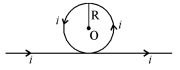
A long wire is bent as shown in the figure. Find the magnitude and direction of magnetic field at center $O$ of the circular part when a current $i$ ampere flows through it.
Image
The metre is defined as the distance travelled by light in $\frac{1}{299,792,458}$ second. Why didn't people choose some 1 easier number such as $\frac{1}{300,000,000}$ second? Why not 1 second?
A parallel beam of light of wavelength 500 nm falls on a narrow slit and the resulting diffraction pattern is observed on a screen 1 m away. It is observed that the first minimum is at a distance of 2.5 mm from the centre of the screen. Find the width of the slit.
Draw 3 equipotential surfaces corresponding to a field that uniformly increases in magnitude but remains constant along Z-direction. How are these surfaces different from that of a constant electric field along Z-direction?
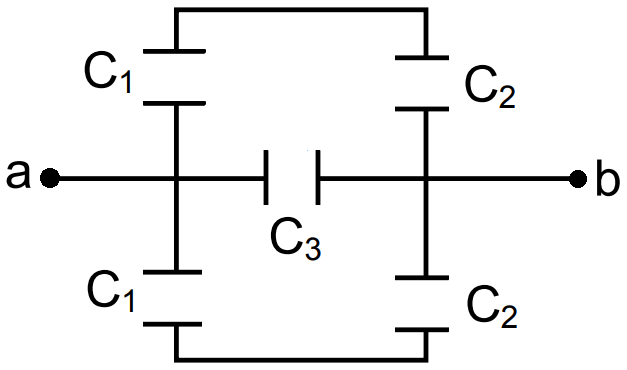
Find the equivalent capacitance of the syatem shown in figure between the points a and b.
A capacitor of capacitance C is given a charge Q. At t = 0, it is connected to an ideal battery of emf $\in$ through a resistance R. Find the charge on the capacitor at time t.