Question
Write the definition of concave mirror and convex mirror.

Answer

Concave mirror : If the outer part is polished and light is reflected from the inner part, then it is called concave mirror.
Convex mirror : If the inner part of a spherical mirror is polished and light is reflected from the outer part, then it is called a convex mirror.

Need a full question paper?

Generate a complete, print-ready paper with questions like this in minutes — across 16+ boards, with answer keys.
Start Generating Free

Similar questions

A carrier wave of peak voltage 15 V is used to transmit a message signal. Find the peak voltage of the modulating signal in order to have a modulation of 60%.
Define electric flux. Write its $S.I.$ units. A spherical rubber balloon carries a charge that is uniformly distributed over its surface. As the balloon is blown up and increases in size, how does the total electric flux coming out of the surface change? Give reason.
A convex lens of focal length $f_1$ is kept in contact with a concave lens of focal length $f_2.$ Find the focal length of the combination.
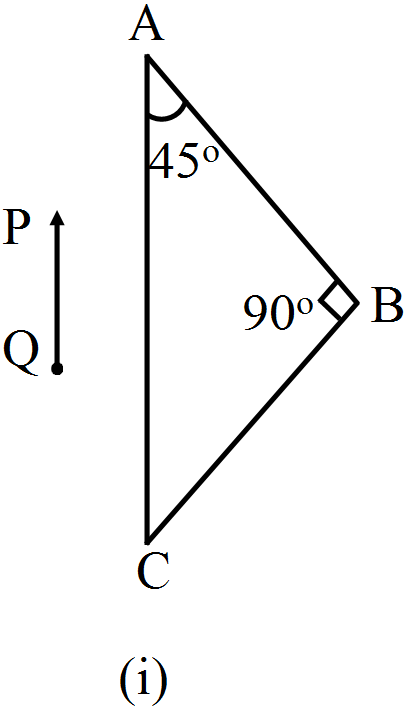
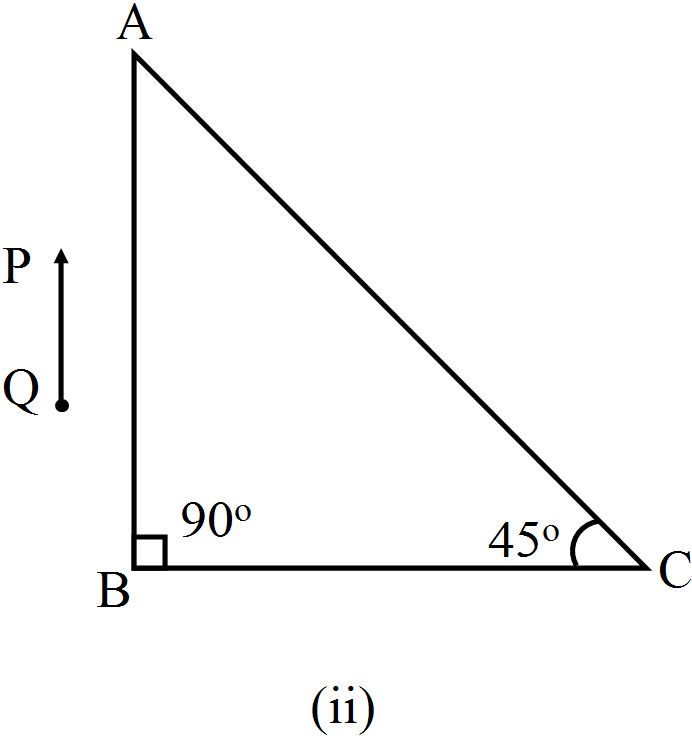
A right-angled crown glass prism with critical angle 41° is placed before an object, PQ in two positions as shown in the figures (i) and (ii). Trace the paths of the rays from P and Q passing through the prisms in the two cases.
Two tuning forks vibrate with the same amplitude but the frequency of the first is double the frequency of the second. Which fork produces more intense sound in air?
$\ce{He_2^3}$ and $\ce{He_1^3}$ nuclei have the same mass number. Do they have the same binding energy?a
Using Bohr’s postulates of the atomic model, derive the expression for radius of $n^{th}$ electron orbit. Hence obtain the expression for Bohr’s radius.
Two magnetic poles, one of which is $10$ times as strong as the other, exert on each other a force equal to $9.604\ mN$ , when placed $10 \ cm$ apart in air. Find the strength of the two poles.
Explain simple microscope. Obtain the equation of magnification for the image formed at near point.
The image of a small electric bulb fixed on the wall of a room is to be obtained on the opposite wall $3 m$ away by means of a large convex lens. What is the maximum possible focal length of the lens required for the purpose?