Question
Write the differences between wind-pollinated and insect-pollinated flowers. Give an example of each type.

Answer

S. No.
Wind-pollinated flowers
Insect-pollinated flowers
(i)
These produce large numbers of pollen grains.
These produce less number of pollen grains.
(ii)
These are dull, nectarless and scentless.
These are bright, scented and have nectar.
(iii)
Stamens are long and protrude above petals.
Stamens lie within the corolla tube.
(iv)
The pollen grains are dry, light, small and smooth. For example, ragweed.
The pollen grains are larger, heavier with appendages like hooks and barbs. For example, rose, sweet pea.

Need a full question paper?

Generate a complete, print-ready paper with questions like this in minutes — across 16+ boards, with answer keys.
Start Generating Free

Similar questions

Classify the following as examples of homology and analogy:
  1. Mouth parts of cockroach and butterfly.
  2. Hearts of rabbits and human beings.
  3. Eyes of octopus and mammals.
  4. Sweet potato and potato.
  5. Stings of honeybee and scorpion.
  6. Tendrils of Lathyrus and tendrils of Gloriosa.
Three water samples namely river water, untreated sewage water and secondary effluent discharged from a sewage treatment plant were subjected to BOD test. The samples were labelled A, B and C; but the laboratory attendant did not note which was which. The BOD values of the three samples A, B and C were recorded as 20mg/L, 8mg/L and 400mg/L, respectively. Which sample of the water is most polluted? Can you assign the correct label to each assuming the river water is relatively clean?
What way the advent of the birth-control pill have resulted in an increase in STDs?
Compare in any three ways the chromosomal theory of inheritance as proposed by Sutton and Bovery with that of experimental results on pea plant presented by Mendel.
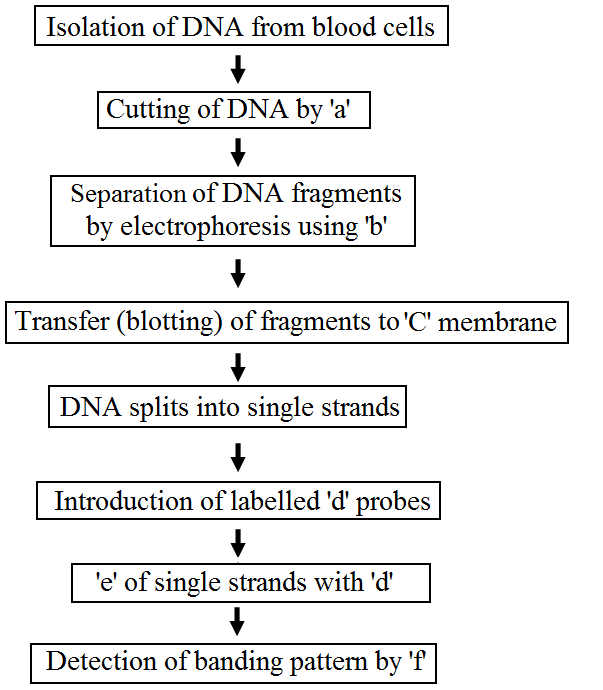
The following is the flowchart highlighting the steps in DNA fingerprinting technique. Identify A, B, C, D, E and F.

Do you agree that regional and local variations exist within each biome? Substantiate your answer with suitable example.
Branching descent and natural selection are the two key concepts of Darwinian Theory of Evolution. Explain each concept with the help of a suitable example.
A species-area curve is drawn by plotting the number of species against the area. How is it that when a very large area is considered the slope is steeper than that for smaller areas?
Why is the length of a food chain in an ecosystem generally limited to 3-4 trophic levels? Explain with an example.
  1. Why does DNA replication occur in small replication forks and not in its entire length?
  2. Why is DNA replication continuous and discontinuous in a replication fork?
  3. Explain the importance of origin of replication' in a replication fork.