Question
Write the differential equation and two difference of time period in linear and angular simple harmonic motion.

Answer

Linear simple harmonic motion differential equation of motion
$
\begin{aligned}
\frac{d^2 y}{dt^2}+\omega^2 y & =0 \\
\omega & =\sqrt{\frac{k}{m}}
\end{aligned}
$
Period of motion $T=2 \pi \sqrt{\frac{m}{ k }}$
Angular simple harmonic motion differential equation of motion
$\frac{ d ^2 \theta}{ dt ^2}+\omega^2 \theta=0$
$\omega=\sqrt{\frac{ C }{ I }}$
Time period of motion $T=2 \pi \sqrt{\frac{ I }{ C }}$

Need a full question paper?

Generate a complete, print-ready paper with questions like this in minutes — across 16+ boards, with answer keys.
Start Generating Free

Similar questions

Is the vector sum of the unit vectors $\vec{\text{i}}$ and $\vec{\text{j}}$ unit vector? If no, can you multiply this sum by a scalar number to get a unit vector?
A tightly closed metal lid of a glass bottle can be opened more easily if it is put in hot water for some time. Explain.
Two cylinders A and B of equal capacity are connected to each other via a stopcock. A contains a gas at standard temperature and pressure. B is completely evacuated. The entire system is thermally insulated. The stopcock is suddenly opened. Answer the following: What is the final pressure of the gas in A and B?
A boy is seated in a revolving chair revolving at an angular speed of 120 revolutions per minute. Two heavy balls form part of the revolving system and the boy can pull the balls closer to himself or may push them apart. If by pulling the balls closer, the boy decreases the moment of inertia of the system from $6kg-m^2$ to $2kg-m^2$, what will be the new angular speed?
Set up a relation between speed of sound in a gas and root mean square velocity of the molecules of that gas.
The efficiency of a Carnot engine for the following temperature differences same is :
(i) 100 K and 500 K
(ii) TK and 900 K
Find the temperature $T$ of the sink.
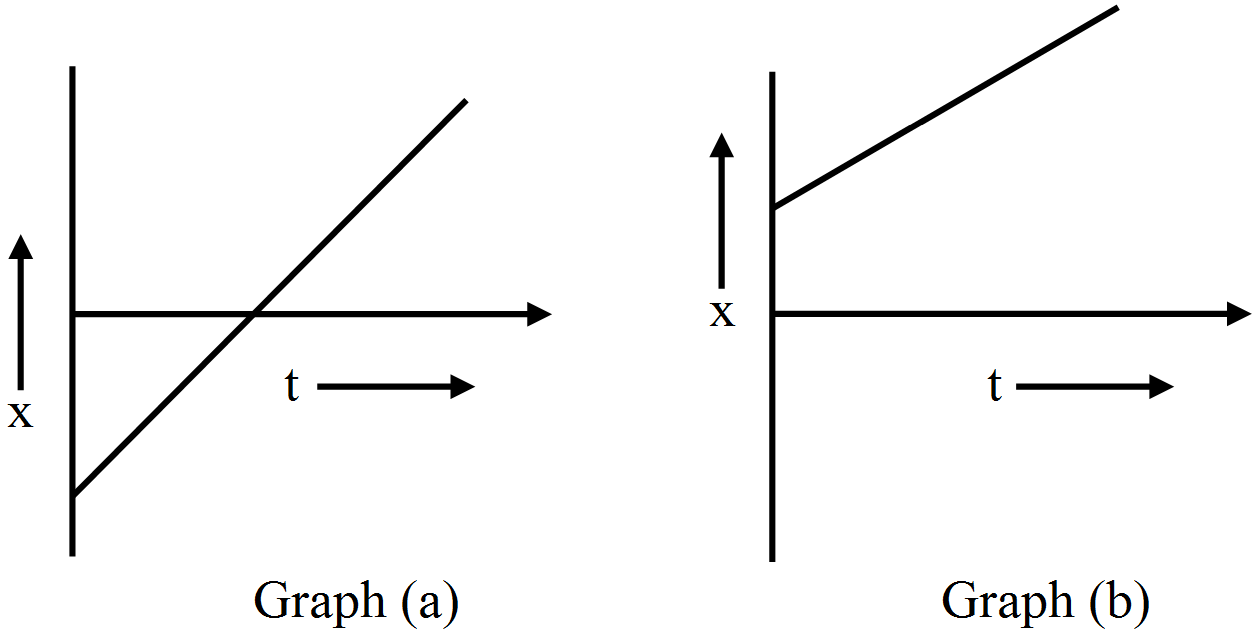
What is common between two graphs shown below?
Calculate the number of degrees of freedom in $15cm^3$ of nitrogen at NTP.
A small disc is set rolling with a speed v on the horizontal part of the track of the previous problem from right to left. To what height will it climb up the curved part?
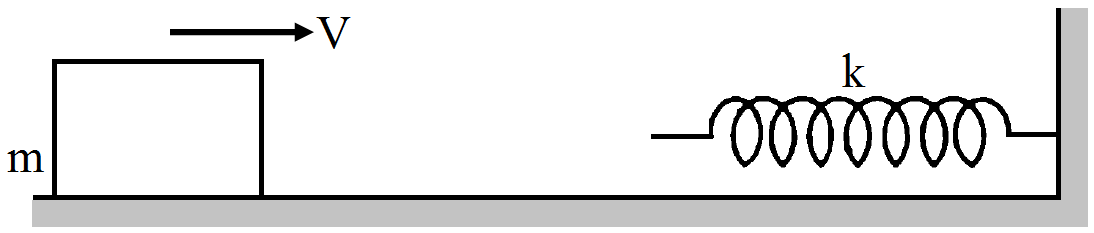
A block of massip, sliding on a smooth horizontal surface with a velocity $\vec{\text{v}}$ meets a long horizontal spring fixed at one end and having spring constant k as shown in figure. Find the maximum compression of tin spring. Will the velocity of the block be the same $\vec{\text{v}}$ when it comes back to the original position shown?