Question
Write the dimensions of the following:
  1. Gravitational potential.
  2. Variable force.
  3. Pressure gradient.
  4. Moment of inertia.
  5. Buoyant force.
  6. Angular momentum.
  7. Work done by torque.
  8. Moment of momentum.
  9. Moment of force.
  10. Pressure energy.

Answer

  1. [M0L2T-2]

  2. [MLT-2]

  3. [ML-2T-2]

  4. [ML2T0]

  5. [MLT-2]

  6. [ML2T-1]

  7. [ML2T-2)

  8. [ML2T-2]

  9. [ML2T-2]

  10. [ML2T-2]

Need a full question paper?

Generate a complete, print-ready paper with questions like this in minutes — across 16+ boards, with answer keys.

Start Generating Free

Similar questions

The gravitational force between two bodies each of mass m and separated by a distance r varies as inversely proportional to the square of the distance r. However, the gravitational force between two solid spheres of same density and same radius r placed in contact with each other is directly proportional to the fourth power of the radius r. Prove it.
A particle moves in a circle of radius 1.0cm at a speed given by v = 2.0t where v is in cm/s and t in seconds.
  1. Find the radial acceleration of the particle at t = 1s.
  2. Find the tangential acceleration at t = 1s.
  3. Find the magnitude of the acceleration at t = 1s.
Artificial diamond crystals have been manufactured by subjecting carbon in the form of graphite to a pressure of 1.55 × 10¹⁰Nm-2 at a high temperature. Assuming that natural dimonds were formed at similar high pressures within the earth, what must have been the original volume o the Kohinoor diamond, whose mass before cutting was about 175g? The density of the diamond= 3.5g/ cm-3 and its bulk modulus = 62 × 1010Nm-2.
Two blocks of masses 10kg and 30kg are placed along a vertical line. The first block is raised through a height of 7cm. By what distance should the second mass be moved to raise the centre of mass by 1cm?
A point object is placed on the principal axis of a convex lens (f = 15cm) at a distance of 30cm from it. A glass plate $(\mu=1.50)$ of thickness 1cm is placed on the other side of the lens perpendicular to the axis. Locate the image of the point object.
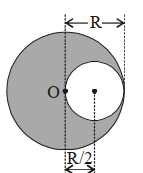
A sphere of radius $R$ has been cut out of $\left(\frac{R}{2}\right)$ solid sphere of radius $R$ as shown in the figure. Find the position of the center of mass of the remaining sphere.
Image
A body, starts from rest and accelerates uniformly, find the ratio of the displacement in:
  1. One, two and three seconds.
  2. First, second and third second.
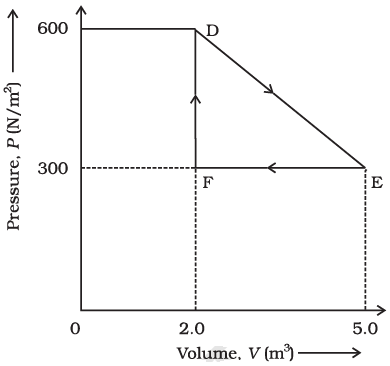
A thermodynamic system is taken from an original state to an intermediate state by the linear process shown in Fig.

Its volume is then reduced to the original value from E to F by an isobaric process. Calculate the total work done by the gas from D to E to F.

A man of mass 70kg stands on a weighing scale in a lift which is moving.
Upwards with a uniform speed of 10 ms-1.
A rod of mass m and length L, lying horizontally, is free to rotate about a vertical axis through its centre. A horizontal force of constant magnitude F acts on the rod at a distance of $\frac{\text{L}}{4}$ from the centre. The force is always perpendicular to the rod. Find the angle rotated by the rod during the time (t) after the motion starts.