Question
Write the expression for the de Broglie wavelength associated with a charged particle having charge ‘q’ and mass ‘m’, when it is accelerated by a potential V.

Answer

de Broglie wavelength $\lambda = \frac{\text{h}}{\text{p}} = \frac{\text{h}}{\sqrt{2\text{mqV}}}$Hint: $\text{W = K qV} = \frac{\text{P}^{2}}{2\text{m}}\text { or } \text{p}= \sqrt{2\text{mqV}}.$

Need a full question paper?

Generate a complete, print-ready paper with questions like this in minutes — across 16+ boards, with answer keys.
Start Generating Free

Similar questions

What is the relation between produced magnetic field at the center of a circular current carrying coil and its radius?
What will be the shape of the wave front emitted by a light source in the form of a narrow slit?
Specific resistance of copper, silver and constantan are $1.18 \times 10^{–6}, 1 \times 10^{–6}, 45 \times 10^6 ohm \ cm$ respectively. Which is the best electrical conductor and why?
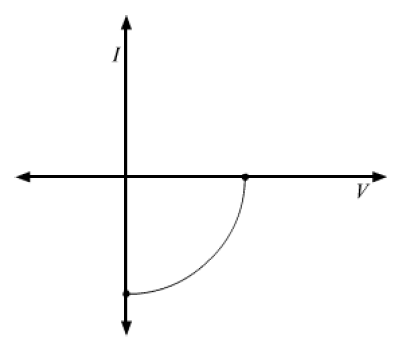
Name the junction diode whose I-V characteristics are drawn below:
The magnetic moment vectors $\mu_\text{s}$ and $\mu_\text{l}$ associated with the intrinsic spin angular momentum S and orbital angular momentum l, respectively, of an electron are predicted by quantum theory (and verified experimentally to a high accuracy) to be given by:
$\mu_\text{s}=-(\text{e}/\text{m})\text{S}.$
$\mu_\text{l}=-(\text{e}/2\text{m})\text{l}.$
Which of these relations is in accordance with the result expected classically? Outline the derivation of the classical result.
What is the length of the telescope in normal adjustment?
Why gold foil is used in $\alpha$-particle scattering experitment?
State with reason, whether the following statement is true or false? "The product of magnetic susceptibility and absolute temperature χT is constant for a paramagnetic material".
Comment on the following statement: the temperature of all the molecules in a sample of a gas is the same.
Magnetic scalar potential is defined as$\text{U}(\overrightarrow{\text{r}_2})-\text{U}(\overrightarrow{\text{r}_1})=-\int\limits^{\vec{\text{r}}_2}_{\vec{\text{r}_1}} \vec{\text{B}}.\text{d}\vec{\text{l}}.$
Apply this equation to a closed curve enclosing a long atraicht wire. The RHS of the above equation is then $-{\mu}_\text{o} \text{ i}$ by Ampere's law. We see that $\text{U}(\vec{\text{r}_2})\neq\text{U}(\vec{\text{r}_1})$ even when $\vec{\text{r}_2}=\vec{\text{r}_1}.$Can we have a magnetic acalar potential in this case?