Question
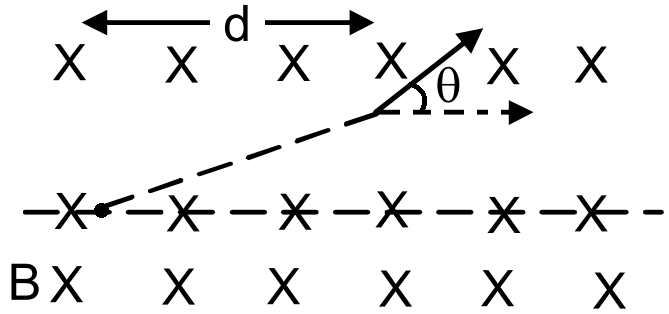
  1. Write the expression for the force, $\overrightarrow{\text{F}}$, acting on a charged particle of charge 'q', moving with a velocity$\overrightarrow{\text{v}}$ in the presence of both electric field $\overrightarrow{\text{E}}$and magnetic field $\overrightarrow{\text{B}}.$ Obtain the condition under which the particle moves undeflected through the fields.
  2. A rectangular loop of size l x b carrying a steady current I is placed in a uniform magnetic field $\overrightarrow{\text{B}}.$ Prove that the torque$\overrightarrow{\tau}$ acting on the loop is given by $\overrightarrow{\tau} =\overrightarrow{\text{m}}\times\overrightarrow{\text{B},}$were $\overrightarrow{\text{m}}$is the magnetic moment of the loop.
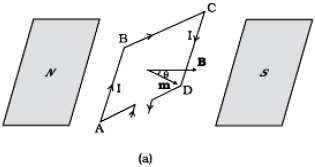
Answer

  1. $\overrightarrow{\text{F}} = \text{q}[\overrightarrow{\text{E}} + (\overrightarrow{\nu}\times\overrightarrow{\text{B}})]$
Condition for undeflected motion
$\overrightarrow{\text{F}} - 0 $
$\rightarrow\text{q}[\overrightarrow{\text{E}} + (\overrightarrow{\nu}\times\overrightarrow{\text{B}})] = 0$
$\Rightarrow\overrightarrow{\text{E}} + \overrightarrow{\nu}\times\overrightarrow{\text{B}} = 0$
$\Rightarrow\overrightarrow{\text{E}} = - (\overrightarrow{\nu}\times\overrightarrow{\text{B}})$
or $\overrightarrow{\text{E}} - \overrightarrow{\text{E}}\times\overrightarrow{\nu}\text{ or }\text{ E} = \text{B } v \sin\theta$
$ =\text{B} \text{v}( \text{When }\theta = 90^{o})$
giving v = E/B when E, B and v are mutually perpendicular.
  1.  


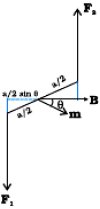
$F_1 = F_2 = IbB$
$\overrightarrow{\tau} = \text{F}_{1}\frac{\text{a}}{2}\sin\theta + \text{F}_{2}\frac{\text{a}}{2}\sin\theta$
$ = \text{I abB} \sin \theta$
$ = \text{I AB }\sin\theta$
But $\text{m} = \text{I A }$
$\therefore\tau = \text{mB}\sin\theta$
$\overrightarrow{\tau} = \overrightarrow{\text{m}}\times\overrightarrow{\text{B}}$
Hence, The sense of $\overrightarrow{\tau}$ is in the sense of $\overrightarrow{\text{m}}\times\overrightarrow{\text{B}}.$

Need a full question paper?

Generate a complete, print-ready paper with questions like this in minutes — across 16+ boards, with answer keys.

Start Generating Free

Similar questions

What is meant by electric potential? Calculate the electric potential generated by a point charge. Draw the equipotential surfaces resulting from this.
$a$. Derive an expression for the impedance of a series $L-C-R$ circuit connected to an $AC$ supply of variable frequency.
$b$. Explain briefly how the phenomenon of resonance in the circuit can be used in the tuning mechanism of a radio or a $TV$ set?
Repeat the previous problem if the particle C is displaced through a distance x along the line AB.
A particle of mass m and charge q is projected into a region that has a perpendicular magnetic field B. Find the angle of deviation of the particle as it comes out of the magnetic field if the width d of the region is very slightly smaller than
  1. $\frac{\text{mv}}{\text{qB}}$
  2. $\frac{\text{mv}}{2\text{qB}}$
  3. $\frac{2\text{mv}}{\text{qB}}.$
Suppose India had a target of producing by 2020 AD, 200,000 MW of electric power, ten percent of which was to be obtained from nuclear power plants. Suppose we are given that, on an average, the efficiency of utilization (i.e. conversion to electric energy) of thermal energy produced in a reactor was 25%. How much amount of fissionable uranium would our country need per year by 2020? Take the heat energy per fission of $^{235}\text{U}$ to be about 200MeV.
A biconvex thick lens is constructed with glass $(\mu=1.50)$ Each of the surfaces has a radius of 10cm and the thickness at the middle is 5cm. Locate the image of an object placed far away from the lens.
The property of diamagnetism is said to be present in all materials. Then, why are some materials paramagnetic or ferromagnetic?
An X-ray tube operates at 40kV. Suppose the electron converts 70% of its energy into a photon at each collision. Find the lowest there wavelengths emitted from the tube. Neglect the energy imparted to the atom with which the electron collides.
A block of mass m is kept on a horizontal ruler. The friction coefficient between the ruler and the block is g. The ruler is fixed at one end and the block is at a distance L from the fixed end. The ruler is rotated about the fixed end in the horizontal plane through the fixed end.
  1. What can the maximum angular speed be for which the block does not slip?
  2. If the angular speed of the ruler is uniformly increased from zero at an angular acceleration $\alpha,$ at what angular speed will the block slip?
Two point charges $q_A = 3 \mu\ C$ and $q_B = –3$ μC are located 20 cm apart in vaccum.
  1. What is the electric field at the midpoint O of the line AB joining the two charges?
  2. If a negative test charge of magnitude $1.5 \times 10^{-9}$ C is placed at this point, what is the force experienced by the test charge?