Question
Write the expression of the common difference of an A.P. whose first term is a and $n^{th}$ term is b.

Answer

Here, we are given
First term $= a$
Last term $= b$
Let us take the common difference as d
Now, we know
$a_n= a + (n - 1)d$
So,
For the last term $(a_n),$
$b = a + (n - 1)d$
$b - a = (n - 1)d$
$\text{d}=\frac{\text{b}-\text{a}}{\text{n}-1}$
Therefore, common difference of the A.P. is $\text{d}=\frac{\text{b}-\text{a}}{\text{n}-1}$.

Need a full question paper?

Generate a complete, print-ready paper with questions like this in minutes — across 16+ boards, with answer keys.
Start Generating Free

Similar questions

A cylindrical tub of radius $5\ cm$ and length $9.8\ cm$ is full of water. A solid in the form of a right circular cone mounted on a hemisphere is immersed in the tub. If the radius of the hemisphere is immersed in the tub. If the radius of the hemi-sphere is $3.5\ cm$ and height of the cone outside the hemisphere is $5\ cm,$ find the volume of the water left in the tube.
$BL$ and $CM$ are medians of ​$\triangle ​ABC$ right angled at A. Prove that $4\left(B^2+C M^2\right)=5 B C^2$
If $15\cot\text{A}=8,$ find the value of $\sin\text{A}$ and $\sec\text{A}.$
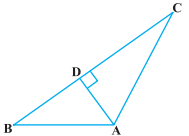
In the given figure, if $AD \bot BC$, prove that $AB^2+ CD^2= BD^2+ AC^2$.
From the top of a $50m$ high tower, the angles of depression of the top and bottom of a pole are observed to be $45^\circ $ and $60^\circ $ respectively. Find the height of the pole.
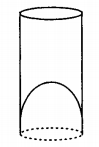
A juice seller was serving his customers using glasses as shown in Figure. The inner diameter of the cylindrical glass was $5 \ cm,$ but the bottom of the glass had a hemispherical raised portion which reduced the capacity of the glass. If the height of a glass was $10 \ cm,$ find the apparent capacity of the glass and its actual capacity. $($Use $\pi = 3.14)$
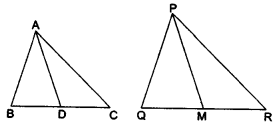
Sides AB and BC and median AD of a triangle ABC are respectively proportional to sides PQ and QR and median PM of $\triangle$PQR (see figure). Show that $\triangle A B C \sim \triangle P Q R$.
How many balls, each of radius $1\ cm$, can be made from a solid sphere of lead of radius $8\ cm?$
The sum of two numbers is $8.$ If their sum is four times their difference, find the numbers.
Very-Short and Short-Answer Qustions:
Write the value of $\tan10^\circ\tan20^\circ\tan70^\circ\tan80^\circ.$