Question
Write the formula for refraction of light at spherical surface (concave or convex). With the help of this formula derive the lens formula : $\frac{1}{f}=(n-1)(\frac{1}{R_{1}}-\frac{1}{R_{2}})$, where symbols used have their usual meanings.

Answer

Formula for refraction at spherical surface (concave or convex) is as follows :
$\frac{n}{v}-\frac{1}{u}=\left(\frac{n-1}{ R }\right)$
where $n$ = refractive index of the medium behind the surface with respect to the medium infront of the surface, R = radius of the curvature of spherical surface, $u$ = distance of object from the surface and $v$ = distance of the image from the surface.
Derivation of the formula : $\frac{1}{f}=(n-1)\left(\frac{1}{ R _1}-\frac{1}{ R _2}\right)$
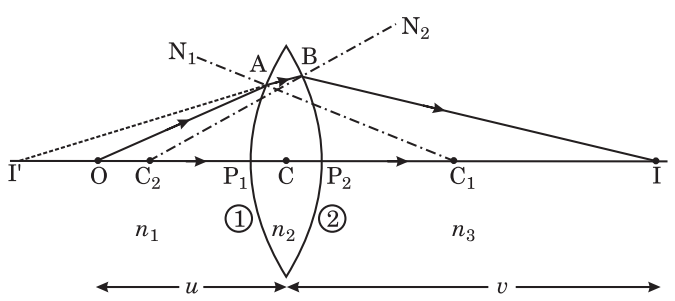
In the ray diagram given below a convex lens 'L' made of absolute refractive index $n_2$ is placed in rarer medium (say air) of absolute refractive index $n_1$ i.e. $n_1 < n_2$.
Image
In this figure P1 , P2 are the poles and C1 , C2 are the centres of curvature of the lens. Hence P1C1 = R1 and P2C2 = R2 are the radii of curvatures of first and second surface of the lens respectively marked as (1) and (2) and P1P2 = t is the thickness of the lens. Let C be the optical centre of the lens.
Suppose O is a point object placed on the principal axis of the lens at a distance u from the pole P1 of surface (1) of the lens. A ray OA is incident on this surface. At A it is refracted from rarer medium into denser medium bending towards normal C1AN1 at A along AB inside the lens. If the surface (2) were absent the ray AB would have met the principal axis at $I^{\prime}$ at a distance $v^{\prime}$ from the pole P1. Hence $I^{\prime}$  can be treated as the real image formed by surface (1). On the basis of formula for refraction at single refracting surface for refraction at surface (1) from rarer medium of refractive index n1 to denser medium of refractive index n2 we have
$\frac{n_2}{v^{\prime}}-\frac{n_1}{u}=\frac{n_2-n_1}{R_1}$ ...(1)
The ray AB travelling in medium n2 is actually incident on the second surface of the lens and is refracted into the rarer medium n1, bending away from the normal C2BN2 at the point B. The emergent ray meets the principal axis at I which is the final, real image of O formed by the lens.
For refraction at the second surface of the lens, $I^{\prime}$ acts as virtual object and I is the real image of $I^{\prime}$ formed by this surface. Let v be the distance of I from the pole P2 of the second surface. The distance of $I^{\prime}$ (object for the second surface) from the pole P2 of the second surface is $\left(v^{\prime}-t\right)$. Then, for refraction at the surface (2) from denser medium $n_2$ to rarer medium $n_1$, we have
$\frac{n_1}{v}-\frac{n_2}{v^{\prime}-t}=\frac{n_1-n_2}{ R _2}$
But for thin lens thickness t << $v^{\prime}$ , hence this can be neglected, so we have
$\frac{n_1}{v}-\frac{n_2}{v^{\prime}}=\left(\frac{n_1-n_2}{ R _2}\right)$
or $\frac{n_1}{v}-\frac{n_2}{v^{\prime}}=-\left(\frac{n_2-n_1}{R_2}\right)$ ...(2)
On adding equation (1) and (2) we get
$\frac{n_1}{v}-\frac{n_1}{u}=\left(n_2-n_1\right)\left(\frac{1}{R_1}-\frac{1}{R_2}\right)$
Dividing both sides by n1 , we get
$\frac{1}{v}-\frac{1}{u}=\left(\frac{n_2}{n_1}-1\right)\left(\frac{1}{ R _1}-\frac{1}{ R _2}\right)$
But n1/n2= n the refractive index of the material of the lens with respect to the surrounding medium,
$\therefore \quad \frac{1}{v}-\frac{1}{u}=(n-1)\left(\frac{1}{R_1}-\frac{1}{R_2}\right)$ ... (3)
But when the object is at infinity the image will be formed at the second focus of the lens i.e., when $u =\infty$, $v$ $=f$ the focal length of the lens. Putting these values of u and v in equation (3), we get
$\frac{1}{f}-\frac{1}{\infty}=(n-1)\left(\frac{1}{ R _1}-\frac{1}{ R _2}\right)$
$\Rightarrow \quad \frac{1}{f}=(n-1)\left(\frac{1}{R_1}-\frac{1}{R_2}\right)$ ...(4)
Equation (4) represents the lens maker's formula.
It has been derived for a convex lens forming a real image, but it is equally applicable to a convex lens forming a virtual image and to a concave lens which forms only virtual image.

Need a full question paper?

Generate a complete, print-ready paper with questions like this in minutes — across 16+ boards, with answer keys.
Start Generating Free

Similar questions

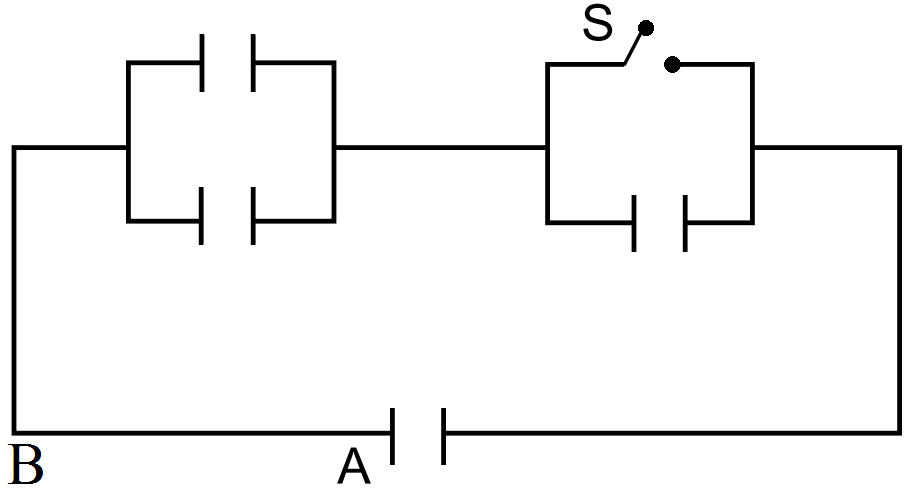
Each capacitor shown in figure has a capacitance of $5.0\mu\text{F}.$ The emf of the battery is 50V. How much charge will flow through AB if the switch S is closed?

Verify the Ampere's law for magnetic field of a point dipole of dipole moment $\text{m}=\text{m}\hat{\text{k}}$. Take C as the closed curve running clockwise along:
  1. The z-axis from z = a > 0 to z = R.
  2. Along the quarter circle of radius R and centre at the origin, in the first quadrant of x-z plane.
  3. Along the x-axis from x = R to x = a.
  4. Along the quarter circle of radius a and centre at the origin in the first quadrant of x-z plane.
If the tension in the cable supporting an elevator is equal to the weight of the elevator, the elevator may be:
  1. Going up with increasing speed.
  2. Going down with increasing speed.
  3. Going up with uniform speed.
  4. Going down with uniform speed.
A glass window is to be fit in an aluminium frame. The temperature on the working day is 40°C and the glass window measures exactly 20cm × 30cm. What should be the size of the aluminium frame so that there is no stress on the glass in winter even if the temperature drops to 0°C ? Coefficients of linear expansion for glass and aluminium are 9.0 × 10⁻⁶ °C-1 and 24 × 10-6 °C-1 respectively.
Consider the de Broglie wavelength of an electron and a proton. Which wavelength is smaller if the two particles have.
  1. The same speed.
  2. The same momentum.
  3. The same energy?.
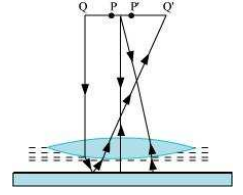
equiconvex lens (of refractive index 1.50) in contact with a liquid layer on top of a plane mirror. A small needle with its tip on the principal axis is moved along the axis until its inverted image is found at the position of the needle. The distance of the needle from the lens is measured to be 45.0 cm. The liquid is removed and the experiment is repeated. The new distance is measured to be 30.0 cm. What is the refractive index of the liquid?

In an experiment on photoelectric effect, the stopping potential is measured for monochromatic light beams corresponding to different wavelengths. The data collected are 11s follows:

wavelength (nm) 350 400 450 500 550
stopping potential(V): 1.45 1.00 0.66 0.38 0.16

Plot the stopping potential against inverse of wavelength $\big(\frac{1}{\lambda}\big) $ on a graph paper and find
  1. The Planck constant,
  2. The work function of the emitter and.
  3. The threshold wavelength.
Explain the vector form of Coulomb's law and write its important facts.
A pin of length 2.00cm is placed perpendicular to the principal axis of a converging lens. An inverted image of size 1.00cm is formed at a distance of 40.0cm from the pin. Find the focal length of the lens and its distance from the pin.
A capacitor of capacitance $5.00\mu\text{F}$ is charged to 24.0V and another capacitor of capacitance $6.0\mu\text{F}$ is charged to 12.0V:
  1. Find the energy stored in each capacitor.
  2. The positive plate of the first capacitor is now connected to the negative plate of the second and vice versa. Find the new charges on the capacitors.
  3. Find the loss of electrostatic energy during the process.
  4. Where does this energy go?