Question
Write the formula for the force per unit length between two parallel current carrying wires. Using it, write the definition of Ampere and Coulomb.
Answer

Image
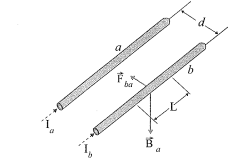
As shown in the figure, two long wires $a$ and $b$ are placed parallel. The (perpendicular) distance between them is $d$. The current passing through them are $I _a$ and $I _b$ respectively.
The force exerted by wire $a$ on a segment of length L on wire $b$ is
$F _{b a}=\frac{\mu_0 I _a I _b L}{2 \pi d}$
Force per unit length
$f_{b a}=\frac{ F _{b a}}{L}=\frac{\mu_0 I _a I _b}{2 \pi d}$
Similarly,
$f_{a b}=\frac{ F _{a b}}{L}=\frac{\mu_0 I _a I _b}{2 \pi d}$
If we take $I _a= I _b=1 A$ and $d=1 m$ in above equation then
$f_{a b}=f_{b a}=2 \times 10^{-7} N$
→Definition of 1 Ampere : "The ampere is the value of that steady current which, when maintained in each of the two very long, straight, parallel conductors of negligible cross-section, and placed one metre apart in vacuum, would produce on each of these conductors a force equal to $2 \times 10^{-7}$ Newtons per metre of length."
→1 Coulomb : "When a steady current of 1 A is set up in a conductor, the amount of charge passing through its cross-section in 1 s is 1 coulomb."

Need a full question paper?

Generate a complete, print-ready paper with questions like this in minutes — across 16+ boards, with answer keys.
Start Generating Free

Similar questions

Write the definition of electric current and ampere $(A)$ and different units of electric current.
The $\text{K}_\beta$ X-ray of argon has a wavelength of 0.36nm. The minimum energy needed to ionize an argon atom is 16eV. Find the energy needed to knock out an electron from the K shell of an argon atom.
An oil drop of $10^{-6} m$ diameter and density $880.5 kg / m ^3$ remains stationary between plates separated by 10 mm . The potential difference between the plates is 36 volts. Find the number of electrons on the oil drop. $\left( g =10 m / s ^2\right)$
Heat at the rate of 200W is produced in an X-ray tube operating at 20kV. Find the current in the circuit. Assume that only a small fraction of the kinetic energy of electrons is converted into X-rays.
A small disc is set rolling with a speed v on the horizontal part of the track of the previous problem from right to left. To what height will it climb up the curved part?
What physical quantity is the same for $Χ-$rays of wavelength $10^{-10}m,$ red light of wavelength $6800\mathring{\text{A}}$ and radio waves of wavelength $500m?$
Describe, with the help of a circuit diagram, the working of a photodiode.
Figure shows a circular wheel of radius $10.0\ cm$ whose upper half, shown dark in the figure, is made of iron and the lower half of wood. The two junctions are joined by an iron rod. A uniform magnetic field $B$ of magnitude $2.00 \times 10^{-4} T$ exists in the space above the central line as suggested by the figure. The wheel is set into pure rolling on the horizontal surface. If it takes $2.00$ seconds for the iron part to come down and the wooden part to go up, find the average emf induced during this period.
Find an expression for intensity of transmitted light when a polaroid sheet is rotated between two crossed polaroids. In which position of the polaroid sheet will the transmitted intensity be maximum?
The mass of a $H-$atom is less than the sum of the masses of a proton and electron. Why is this?