Question
Write the general outer electronic configuration of s-, p-, d- and f- block elements.

Answer

  1. s-Block elements: ns1-2 where n = 2 – 7.
  2. p-Block elements: ns2 np1-6 where n = 2 - 6.
  3. d-Block elements: (n – 1) d1-10 ns0-2  where n = 4 - 7.
  4. f-Block elements: (n – 2) f0-14 (n - 1) d0-1 nswhere n = 6 – 7.

Need a full question paper?

Generate a complete, print-ready paper with questions like this in minutes — across 16+ boards, with answer keys.

Start Generating Free

Similar questions

Note: Consider structures I to VII and answer the questions:

  1. $\text{CH}_3-\text{CH}_2-\text{CH}_2-\text{CH}_2-\text{OH}$

  2. $\text{CH}_3-\text{CH}_2-\text{CH}-\text{CH}_3\\\ \ \ \ \ \ \ \ \ \ \ \ \ \ \ \ \ \ \ \ \ \ \ \ \ \ |\\\ \ \ \ \ \ \ \ \ \ \ \ \ \ \ \ \ \ \ \ \ \ \ \ \ \text{OH}$

  3. $\ \ \ \ \ \ \ \ \ \ \ \ \text{CH}_3\\\ \ \ \ \ \ \ \ \ \ \ \ \ |\\\text{CH}_3-\text{C}-\text{CH}_3\\\ \ \ \ \ \ \ \ \ \ \ \ \ |\\\ \ \ \ \ \ \ \ \ \ \ \ \text{OH}$

  4. $\text{CH}_3-\text{CH}-\text{CH}_2-\text{OH}\\\ \ \ \ \ \ \ \ \ \ \ \ \ \ \ \ \ \ \ \ \ \ \ \ |\\\ \ \ \ \ \ \ \ \ \ \ \ \ \ \ \ \ \ \ \ \ \ \ \text{CH}_3$

  5. $\text{CH}_3-\text{CH}_2-\text{O}-\text{CH}_2-\text{CH}_3$

  6. $\text{CH}_3-\text{O}-\text{CH}_2-\text{CH}_2-\text{CH}_3$

  7. $\text{CH}_3-\text{O}-\text{CH}-\text{CH}_3\\\ \ \ \ \ \ \ \ \ \ \ \ \ \ \ \ \ \ \ \ \ \ |\\\ \ \ \ \ \ \ \ \ \ \ \ \ \ \ \ \ \ \ \ \ \text{CH}_3$
Which of the above compounds form pairs of metamers?

Calculate the molarity of a solution of ethanol in water, in which the mole fraction of ethanol is 0.040 (assume the density of water to be one).
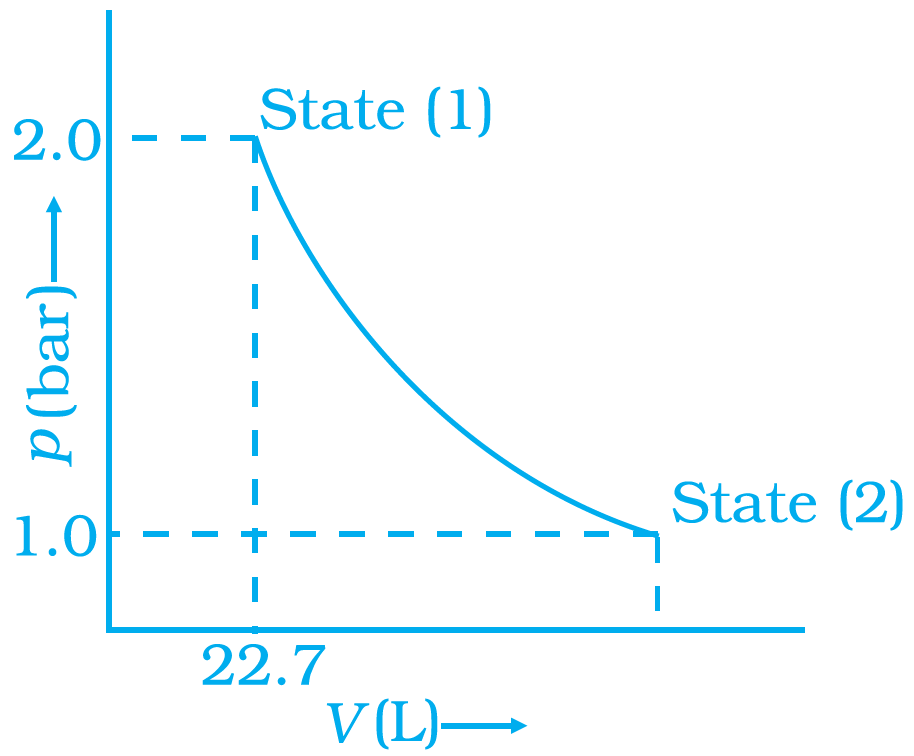
1.0 mol of a monoatomic ideal gas is expanded from state (1) to state (2) as shown in Fig. Calculate the work done for the expansion of gas from state (1) to state (2) at 298K.

Write comments on the following:
(a) Pauli's exclusion law
(b) n +$l$ rule
1. a. Define the following terms:
i. Enantiomers
ii. Racemic mixture
b. Why is chlorobenzene resistant to nucleophilic substitution reaction?
2. What is the general molecular formula of saturated monohydric alcohols?
Show that the circumference of the Bohr orbit for the hydrogen atom is an integral multiple of the de Broglie wavelength associated with the electron revolving around the orbit.
One mole of H2O and one mole of CO are taken in 10L vessel and heated to 725K. At equilibrium 40% of water (by mass) reacts with CO according to the equation,
$\text{H}_2\text{O (g) + CO (g)}\rightleftharpoons\text{H}_2\text{ (g) + CO}_2\text{ (g)}$
Calculate the equilibrium constant for the reaction.
Briefly describe the valence bond theory of covalent bond formation by taking an example of hydrogen. How can you interpret energy changes taking place in the formation of dihydrogen?
Ethyl acetate is formed by the reaction of ethanol and acetic acid and the equilibrium is represented as:
$
CH_3 COOH(l)+C_5 H_5 OH(l) \rightleftharpoons CH_3 COOC_2 H_5(l)+H_2 O(l)
$
a. Write the concentration ratio (reaction quotient), $Q _{ C }$, for this reaction (note: water is not in excess and is not a solvent in this reaction)
b. At 293 K , if one starts with 1.00 mol of acetic acid and 0.18 mol of ethanol, there is 0.171 mol of ethyl acetate in the final equilibrium mixture. Calculate the equilibrium constant.
c. Starting with 0.5 mol of ethanol and 1.0 mol of acetic acid and maintaining it at $293 K, 0.214$ mol of ethyl acetate is found after some time. Has equilibrium been reached?
What is Hess's law? Explain with examples.