Question
Write the history of magnet in brief.

Answer

→We know that a magnet possesses the property of attracting iron.
→Magnetic phenomena are universal in nature. The earth's magnetism predates human evolution.
→The word magnet is derived from the name of an island in Greece called 'magnesia' where magnetic ore deposits were found, around 600 BC .
→Shepherds on this island complained that their wooden shoes (which had nails) at times stuck to the ground. This property of magnets made it difficult for them to move around.
→The directional property of magnets was also known since ancient times. A thin and long piece of a magnet, when suspended freely, points in the north-south direction.
→The name loadstone (OR lode stone) was given to a naturally occuring ore of iron-magnetite, which means leading stone.
→The very first use of magnet (OR magnetic needles) was done by the Chinese for navigation on ships.
→Caravans crossing the Gobi Desert also employed magnetic needles.
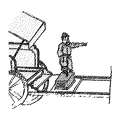
→About four thousand years ago, an emperor Huang-ti got built a chariot by his craftsmen ('engineers' of today) on which they placed a magnetic figure with arms out stretched.
Image
→The figure swiveled around so that the figure of the statuette on it always pointed south. With this chariot, Huang-ti's troops were able to attack the army of enemy from the rear in thick fog, and were able to defeat them.
Need a full question paper?

Generate a complete, print-ready paper with questions like this in minutes — across 16+ boards, with answer keys.

Start Generating Free

Similar questions

If the resultant torque of all the forces acting on a body is zero about a point, is it necessary that it will be zero about any other point?
A particle starting from rest moves with constant acceleration. If it takes 5.0s to reach the speed 18.0km/h find:
  1. The average velocity during this period.
  2. The distance travelled by the particle during this period.
Answer the following question:
You have learnt that plane and convex mirrors produce virtual images of objects. Can they produce real images under some circumstances? Explain.
Two cells of emfs 1.5 V and 2.0 V having internal resistances 0.2 $\Omega$ and 0.3 $\Omega$respectively are connected in parallel. Calculate the emf and internal resistance of the equivalent cell.
Explain that in day to day life we can't get coherent sources using two sodium lamps.
A charge $Q$ is placed at the centre of an imaginary hemispherical surface. Using symmetry arguments and the Gauss's law, find the flux of the electric field due to this charge through the surface of the hemisphere $($figure$).$
A capacitor with capacitance C is changed to potential V. What is its electrical energy ?
Show that the electrostatic potential is constant throughout the volume of the conductor and has the same value (as inside) on its surface.
Find the dimensions of Planck's constant h from the equation E = hv where E is the energy and v is the frequency.
On increasing the current drawn from a cell, the net potential difference across its terminals is lowered, why?