Question
Write the history of magnet in brief.

Answer

→We know that a magnet possesses the property of attracting iron.
→Magnetic phenomena are universal in nature. The earth's magnetism predates human evolution.
→The word magnet is derived from the name of an island in Greece called 'magnesia' where magnetic ore deposits were found, around 600 BC .
→Shepherds on this island complained that their wooden shoes (which had nails) at times stuck to the ground. This property of magnets made it difficult for them to move around.
→The directional property of magnets was also known since ancient times. A thin and long piece of a magnet, when suspended freely, points in the north-south direction.
→The name loadstone (OR lode stone) was given to a naturally occuring ore of iron-magnetite, which means leading stone.
→The very first use of magnet (OR magnetic needles) was done by the Chinese for navigation on ships.
→Caravans crossing the Gobi Desert also employed magnetic needles.
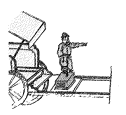
→About four thousand years ago, an emperor Huang-ti got built a chariot by his craftsmen ('engineers' of today) on which they placed a magnetic figure with arms out stretched.
Image
→The figure swiveled around so that the figure of the statuette on it always pointed south. With this chariot, Huang-ti's troops were able to attack the army of enemy from the rear in thick fog, and were able to defeat them.

Need a full question paper?

Generate a complete, print-ready paper with questions like this in minutes — across 16+ boards, with answer keys.

Start Generating Free

Similar questions

A block of mass m is kept on a horizontal table. If the static friction coefficient is $\mu,$ find the frictional force acting on the block.
i. Define the terms: impact parameter and distance of closest approach for an -particle in the GeigerMarsden scattering experiment.
ii. What will be the value of the impact parameter for scattering angle (I) $\theta=0^{\circ}$ and (II) $\theta=180^{\circ}$ ?
Consider an amplifier circuit using a transistdf. The output power is several times greater than the input power. Where does the extra power come from?
Find the dimensions of:

  1. The specific heat capacity c.
  2. The coefficient of linear expansion a.
  3. The gas constant R.
Some of the equations involving these quantities are

$\text{Q = mc(T}_2-\text{T}_1),\text{l}_{\text{t}}=\text{l}_0[1+\alpha(\text{T}_2-\text{T}_1)]$ and $\text{PV = nRT}.$

Briefly explain the discovery of neutrons.
Answer the following questions: The angle subtended at the eye by an object is equal to the angle subtended at the eye by the virtual imae produced by a magnifying glass. In what sense then does a magnifying glass provide angular magnification?
In an electrolyte, the positive ions move from left to right and the negative ions from right to left. Is there a net current? If yes, in what direction?
A simple microscope using a single lens often shows coloured image of a white source. Why?
Write briefly the underlying principle used in Davison-Germer experiment to verify wave nature of electrons experimentally. What is the de-Broglie wavelength of an electron with kinetic energy (of).120 ev? Write briefly the underlying principle used in Davison-Germer experiment to verify wave nature of electrons experimentally. What is the de-Broglie wavelength of an electron with kinetic energy (of).120 ev?
Explain the refraction of a plane wave from rarer medium to a denser medium, using Huygen's principle.