MCQ
Write the $IUPAC$ name of  $\begin{array}{*{20}{c}}
  {\,\,\,\,H\,\,\,\,\,\,\,\,\,\,\,\,\,\,\,\,\,\,\,\,\,\,\,\,\,\,\,\,\,\,\,\,\,\,\,\,\,\,\,\,\,\,\,\,\,\,\,\,\,\,\,\,\,\,\,\,\,\,\,Br} \\ 
  {\,|\,\,\,\,\,\,\,\,\,\,\,\,\,\,\,\,\,\,\,\,\,\,\,\,\,\,\,\,\,\,\,\,\,\,\,\,\,\,\,\,\,\,\,\,\,\,\,\,\,\,\,\,\,\,\,\,\,\,\,\,\,\,\,\,\,|} \\ 
  {C{H_3} - C - C{H_2} - C{H_2} - C{H_2} - C - C{H_3}} \\ 
  {\,|\,\,\,\,\,\,\,\,\,\,\,\,\,\,\,\,\,\,\,\,\,\,\,\,\,\,\,\,\,\,\,\,\,\,\,\,\,\,\,\,\,\,\,\,\,\,\,\,\,\,\,\,\,\,\,\,\,\,\,\,\,\,\,\,\,\,|} \\ 
  {\,\,OH\,\,\,\,\,\,\,\,\,\,\,\,\,\,\,\,\,\,\,\,\,\,\,\,\,\,\,\,\,\,\,\,\,\,\,\,\,\,\,\,\,\,\,\,\,\,\,\,\,\,\,\,\,\,\,\,\,\,\,Br} 
\end{array}$
  • $6, 6-$dibromoheptane$-2-$ol
  • B
    $2, 2-$dibromoheptane$-6-$ol
  • C
    $6, 6 $dibromoheptane$-2-$ol
  • D
    None of these

Answer

Correct option: A.
$6, 6-$dibromoheptane$-2-$ol
a
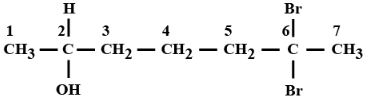
The IUPAC name of the given compound is $6,6$-Dibromoheptan-$2$-ol. The number is shown below in the structure. Here $- OH$ is the main functional group, while $- Br$ is the secondary group and is named as prefix.

Need a full question paper?

Generate a complete, print-ready paper with questions like this in minutes — across 16+ boards, with answer keys.

Start Generating Free

Similar questions

If the enthalpy change for the transition of liquid water to steam is $30\ kJ\ mol^{-1}$ at $27\,^oC,$ the entropy change for the process would be ............. $\mathrm{J\,mol}^{-1}\, \mathrm{K}^{-1} $
The value of the energy for the first excited state of hydrogen atom will be ............. $\mathrm{eV}$
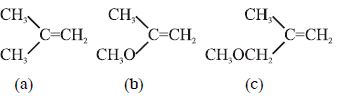
Arrange the above in the decreasing order of reactivity towards $HBr.$
The compounds that will give an isomer of  $2; 2-$ dimethyl propane on catalytic hydrogenation are

$(1)$ $\begin{array}{*{20}{c}}
  {C{H_3}CH = C - C{H_3}} \\ 
  {\,\,\,\,\,\,\,\,\,\,|} \\ 
  {\,\,\,\,\,\,\,\,\,\,\,\,\,\,\,\,C{H_3}} 
\end{array}$

$(2)$ $C{H_3}CH = CHC{H_3}$

$(3)$ $\mathop {C{H_3}C}\limits^{\begin{subarray}{l} 
  \,\,\,\,\,\,\,\,{\begin{array}{*{20}{c}}
  {}&H 
\end{array}} \\ 
  \,\,\,\,\,\,\,\,\,\,\,\,\,\,| 
\end{subarray} }  = CHC{H_2}C{H_3}$

$(4)$ $\begin{array}{*{20}{c}}
  {C{H_3}C = C - C{H_3}} \\ 
  {\,\,\,\,\,\,\,|\,\,\,\,\,\,\,\,\,\,\,\,|\,\,\,\,\,\,\,\,\,\,\,\,\,} \\ 
  {\,\,\,\,\,\,\,\,\,\,\,\,\,C{H_{3\,\,}}\,\,C{H_3}\,\,\,\,\,\,\,\,\,\,\,\,\,\,\,\,} 
\end{array}$

In reaction $A + 2B  \rightleftharpoons  2C + D$, initial concentration of $B$ was $1.5$ times of $[A]$, but at equilibrium the concentrations of $A$ and $B$ became equal. The equilibrium constant for the reaction is
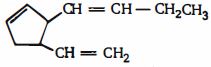
Total number of stereoisomers possible for following compound is
Which of the following statements is incorrect for $PCl_5$ ?
The weight of $1 \times {10^{22}}$molecules of $CuS{O_4}.5{H_2}O$ is ........... $\mathrm{g}$
The reaction rate for the reaction

$\left[\mathrm{PtCl}_{4}\right]^{2-}+\mathrm{H}_{2} \mathrm{O} \rightleftharpoons\left[\mathrm{Pt}\left(\mathrm{H}_{2} \mathrm{O}\right) \mathrm{Cl}_{3}\right]^{-}+\mathrm{Cl}^{-}$

was measured as a function of concentrations of different species. It was observed that

$\frac{-\mathrm{d}\left[\left[\mathrm{PtCl}_{4}\right]^{2-}\right]}{\mathrm{dt}}=4.8 \times 10^{-5}\left[\left[\mathrm{PtCl}_{4}\right]^{2-}\right]-2.4 \times10^{-3}\left[\left[\mathrm{Pt}\left(\mathrm{H}_{2} \mathrm{O}\right) \mathrm{Cl}_{3}\right]^{-}\right]\left[\mathrm{Cl}^{-}\right]$

where square brackets are used to denote molar concentrations. The equilibrium constant $\mathrm{K}_{\mathrm{c}}=....$. (Nearest integer)

Which of the following oxide is strongest base?