Question
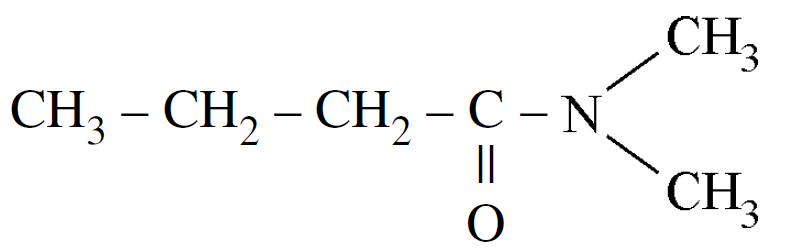
Write the IUPAC name of the given compound.

Answer

N, N-dimethylbutanamide

Need a full question paper?

Generate a complete, print-ready paper with questions like this in minutes — across 16+ boards, with answer keys.

Start Generating Free

Similar questions

Suggest two materials other than hydrogen that can be used as fuels in fuel cells.
Some enzymes are named after the reaction, where they are used. What name is given to the class of enzymes which catalyse the oxidation of one substrate with simultaneous reduction of another substrate?
In Kolbe’s reaction, instead of phenol, phenoxide ion is treated with carbon dioxide. Why?
Which of the following isomers is more volatile:
o-nitrophenol or p-nitrophenol?
Bring out the following conversion:
Acetaldehyde to Ethane.
In an aqueous solution how does specific conductivity of electrolytes change with addition of water?
Read the given passage and answer the questions number 1 to 5 that follow:
The substitution reaction of alkyl halide mainly occurs by SN1 or SN2 mechanism. Whatever mechanism alkyl halides follow for the substitution reaction to occur, the polarity of the carbon halogen bond is responsible for these substitution reactions. The rate of SN1 reactions are governed by the stability of carbocation whereas for SN2 reactions steric factor is the deciding factor. If the starting material is a chiral compound, we may end up with an inverted product or racemic mixture depending upon the type of mechanism followed by alkyl halide. Cleavage of ethers with HI is also governed by steric factor and stability of carbocation, which indicates that in organic chemistry, these two major factors help us in deciding the kind of product formed.
Predict the stereochemistry of the product formed if an optically active alkyl halide undergoes substitution reaction by SN1 mechanism.
Suggest the most important type of intermolecular attractive interaction in the following pairs.
I2 and CCl4.
Name the following halides according to IUPAC system and classify them as alkyl, allyl, benzyl (primary, secondary, tertiary), vinyl or aryl halides:
m-ClCH2C6H4CH2C(CH3)3
Complete each synthesis by giving missing starting material, reagent or product.

$\text{C}_6\text{H}_5\text{CHO}+\text{CH}_3\text{CH}_2\text{CHO}\xrightarrow{\text{dil.NaOH}}$