Question
Write the kinematical equations for circular motion in analogy with linear motion.

Answer

For circular motion of a particle with constant angular acceleration $\alpha$, average angular speed, $\omega_{\mathrm{av}}=\frac{\omega_0+\omega}{2}$
$
\alpha=\frac{\omega-\omega_0}{t} \text { and } \begin{gathered} \\
\theta-\theta_0=\omega_{\text {av }} \cdot t
\end{gathered}
$
where $\omega_0$ and $\omega$ are the initial and final angular speeds, $t$ is the time, $\omega_{a v}$ the average angular speed and 00 and 0 the initial and final angular positions of the particle.
Then, the angular kinematical equations for the circular motion are (in analogy with linear kinematical equations for constant linear acceleration)
$
\begin{aligned}
& \omega=\omega_0+\alpha t \\
& \theta-\theta_0=\omega_0 t+\frac{1}{2} \alpha t^2 \\
& \omega^2=\omega_0^2+2 \alpha\left(\theta-\theta_0\right)
\end{aligned}
$

Need a full question paper?

Generate a complete, print-ready paper with questions like this in minutes — across 16+ boards, with answer keys.
Start Generating Free

Similar questions

State the conditions for constructive and destructive interference of light.
In a double-slit arrangement the slits are separated by a distance equal to 100 times the wavelength of the light passing through the slits.
(a) What is the angular separation in radians between the central maximum and an adjacent maximum?
(b) What is the distance between these maxima on a screen 50.0 cm from the slits?
 
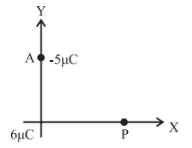
A charge $6 \mu C$ is placed at the origin and another charge $-5 \mu C$ is placed on the y axis at a position $A (0, 6.0)$ m.
Image
(a) Calculate the total electric potential at the point P whose coordinates are $(8.0, 0)$ m
(b) Calculate the work done to bring a proton from infinity to the point P. What is the significance of the sign of the work done ?
Two organ pipes open at both ends and of same length but different radii (or diameters) produce sounds of different frequencies. Why?
A set of $8$ tuning forks is arranged in a series of increasing order of frequencies. Each fork gives $4$ beats per second with the next one and the frequency of last for $k$ is twice that of the first. Calculate the frequencies of the first and the last for $k.$ [Ans:$28\ Hz, 56\ Hz$]
State Bohr's third postulate for hydrogen $(H_2)$ atom. Derive Bohr's formula for the wave number. Obtain expressions for longest and shortest wavelength of spectral lines in ultraviolet region for hydrogen atom.
What are the uses of logic gates? Why is a NOT gate known as an inverter?
Explain
(1) free vibrations
(2) forced vibrations.
Explain the terme sharpness of resonance and $Q$ factor (quality factor).
What is diamagnetism?