Question
Write the Lewis dot structure of the CO molecule.
Answer

Step 1. Count the total number of valence electrons of carbon and oxygen atoms. The outer (valence) shell configurations of carbon and oxygen atoms are:
$2 s^2 2 p^2$ and $2 s^2 2 p^4$, respectively. The valence electrons available are $4+6=10$.
Step 2. The skeletal structure of CO is written as: CO
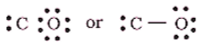
Step 3. Draw a single bond (one shared electron pair) between $C$ and $O$ and complete the octet on $O$, the remaining two electrons are the lone pair on C .
Image
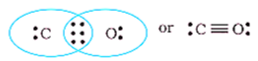
This does not complete the octet on carbon and hence we have to resort to multiple bonding (in this case a triple bond) between C and O atoms. This satisfies the octet rule condition for both atoms. 
Image

Need a full question paper?

Generate a complete, print-ready paper with questions like this in minutes — across 16+ boards, with answer keys.

Start Generating Free

Similar questions

Write balanced chemical equation for the following reactions:
Reaction of liquid hydrazine (N2H4) with chlorate ion (ClO3) in basic medium produces nitric oxide gas and chloride ion in gaseous state.
(Balance by oxidation number method)
What is meant by reaction quotient? Give its expression.
Indicate the number of $\sigma$ and $\pi$ bonds in the molecule $\text{CH}_2=\text{C}=\text{CH}_2.$
Which of the species have same bond order and paramagnetic? Give reason.

$\text{N}_2,\text{F}^+_2,\text{N}^-_2,\text{O}^-_2$
5.975g of the higher oxide of metal gave 5.575g of lower oxide on heating. The quantity of the lower oxide gave 5.175g of metal on reduction. Prove that these results are in accordance with the law of multiple proportions.
100 mL of a liquid is contained in an insulated container at a pressure of 1 bar. The pressure is steeply increased to 100 bar. The volume of the liquid is decreased by 1 mL at this constant pressure. Find $\Delta H$ and $\Delta U$.
Why common salt is added to precipitate out soap from the solution during its manufacture?
Arrange the following according to bond length and bond dissociation energy giving reasons:
  1. $\text{H}-\text{F},\text{H}-\text{Cl},\text{H}-\text{Br},\text{H}-\text{I}$
  2. $\text{C}-\text{C},\text{C}=\text{C},\text{C}\equiv\text{C}$
  3. $\text{C}-\text{H}$ bond lenth in CH4, C2H4 and C2H2