Question
Write the mathematical relation between mobility and drift velocity of charge carriers in a conductor. Name the mobile charge carriers responsible for conduction of electric current in (i) an electrolyte (ii) an ionised gas.

Answer

  1. $\mu=\frac{V_{d}}{E}$
  2. .
    1. Ions/Positive and negative ions.
    2. Electrons/Positive ions/Electrons and positive ions.

Need a full question paper?

Generate a complete, print-ready paper with questions like this in minutes — across 16+ boards, with answer keys.
Start Generating Free

Similar questions

Assume that the magnetic field is uniform in a cubical region and is zero outside. Can you project a charged particle from outside into the field so that the particle describes a complete circle in the field?
The average kinetic energy of molecules in a gas at temperature T is 1.5kT. Find the temperature at which the average kinetic energy of the molecules of hydrogen equals the binding energy of its atoms. Will hydrogen remain in molecular from at this temperature? Take $\mathrm{k}=8.62 \times 10^{-5} \mathrm{eVK}^{-1}$.
What is Rectifier?
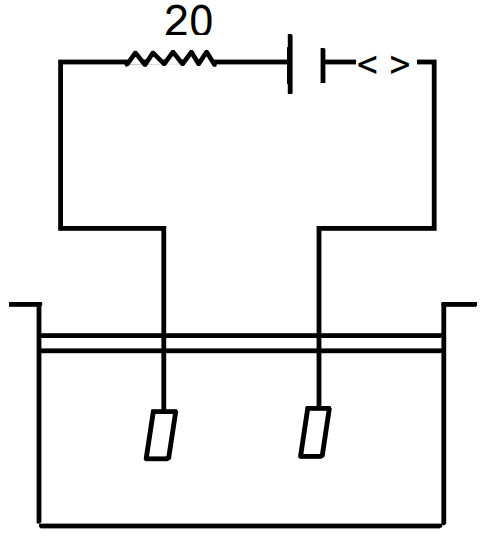
Figure shows an electrolyte of AgCl through which a current is passed. It is observed that 2.68g of silver is deposited in 10 minutes on the cathode. Find the heat developed in the $20\Omega$ resistor during this period. Atomic weight of silver is 107.9g/mole.
X-rays of wavelength $'\lambda'$ fall on a photosensitive surface, emitting electrons. Assuming that the work function of the surface can be neglected, prove that the de Broglie wavelength of electrons emitted will be $\sqrt{\frac{\text{h}\gamma}{2\text{mc}}}.$
Assuming the nuclei to be spherical in shape, how does the surface area of a nucleus of mass number $A_1$ compare with that of a nucleus of mass number $A_2?$
Show that there can be no net charge in a region m which the electric field is uniform at all points.
Write relation between conductivity and mobility of metal.
Which one of the two, an ammeter or a milliammeter, has a higher resistance and why?
Draw a plot showing the variation of (i) electric field (E) and (ii) electric potential (V) with distance r due to a point charge Q.