Question
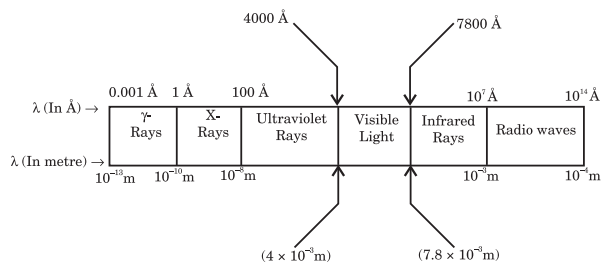
Write the name of different waves in electromagnetic spectrum and give brief introduction of their discovery, wavelength range, properties and applications.

Answer

1. $\gamma$ - Rays:
Wavelength range $10^{-13}$ to $10^{-10}$ metre.
Discovery - by Becquerel. (1896) and Curie (1898)
Production - By natural and artificial disintegration of radioactive substances.
Properties -They produce invisible, penetration and fluorescene, phosphorescence, ionisation and diffraction.
Applications-These are used to get the information about the structure of atomic nuclei.
2. X-Rays:
Wavelength range $10^{-10}$ to $10^{-8}$ metre.
Discovery-By Rontgen (1895)
Production - By bombardment of cathode rays on metal targets.
Properties-They are less penetrating than $\gamma$ - rays but more pennetrating than visible rays. They affect photographic plates. In human body tissues are transparent to them but bones are relatively opaque.
Applications - These are used to get the information about atomic structure and crystal structure and also used in medical diagnosis.
3. Ultraviolet Rays :
Wavelength range $10^{-8}$ to $4\times10^{-7}$ metre.
Discovery - Ritter (1802), Schuman (1890) and Lyman (1906).
Production - By electric discharge and vacuum spark.
Properties -They are very active. They show maxi-mum chemical effect and minimum heating effect.
Applications- These are useful in the detection of invisible writing, forged documents and finger prints.
4. Visible Rays (Light rays) :
Wavelength range $4\times10^{-7}$ to $7.8\times10^{-7}$ metre.
Discovery - Newton
Production - Reflection, refraction, interference diffration, polarisation, photo-electric effect, photographic action, sense of sight.
Applications -To see object by the eyes.
5. Infrared rays :
Wavelength range $7.8\times10^{-7}$ to $10^{-3}$ metre.
Discovery - By Herschell (1840)
Production - By heating the substance to a very high temperature.
Properties - Having more invisible penetrating effect on thermopile, bolometer.
Applications - These are used in revealing the secret writings on the ancient walls green houses to keep the plants warm and for looking through haze, fog or mist.
6. Radio Waves :
(a) Hertzian Waves or Short Radio Waves: i.e., Micro waves
Wavelength Range $10^{-3}$ to 1 metre.
Discovery - By Hertz (1888)
Image
Production - By spark gap.
Properties -They show reflection, refraction and interference.
Applications -These are used in radar and television.
(b) Long Radio waves or Wireless waves :
Wavelength range -104 metre.
Discovery - By Marconi (1896)
Production-When a ratio walve is used as an oscillator these waves are produced.
Properties-These waves are used in radio and wireless telegraphy. They show reflection, refraction and diffraction.
Applications-These are used in radio broadcasting.

Need a full question paper?

Generate a complete, print-ready paper with questions like this in minutes — across 16+ boards, with answer keys.
Start Generating Free

Similar questions

The $\text{K}_\alpha$ and $\text{K}_\beta$ X-rays of molybdenum have wavelengths 0.71A and 0.63A respectively. Find the wavelength of $\text{L}_\alpha$ X-ray of molybdenum.
A compound microscope consists of an objective of focal length 1cm and an eyepiece of focal length 5cm. An object is placed at a distance of 0.5cm from the objective. What should be the separation between the lenses so that the microscope projects an inverted real image of the object on a screen 30cm behind the eyepiece?
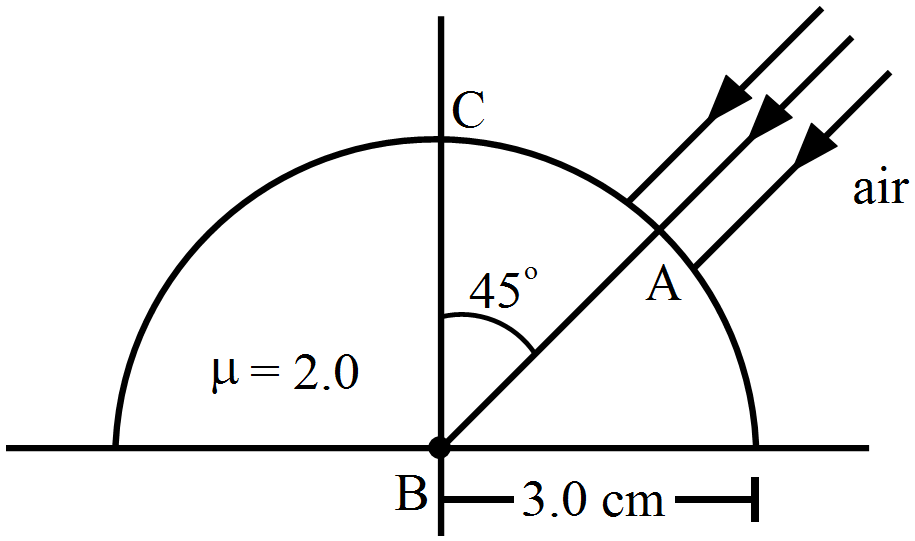
Figure shows a transparent hemisphere of radius 3.0cm made of a material of refractive index 2.0.
  1. A narrow beam of parallel rays is incident on the hemisphere as shown in the figure. Are the rays totally reflected at the plane surface?
  2. Find the image formed by the refraction at the first surface.
  3. Find the image formed by the reflection or by the refraction at the plane surface.
  4. Trace qualitatively the final rays as they come out of the hemisphere.

A convex lens of focal length 20cm and a concave lens of focal length 10cm are placed 10cm apart with their principal axes coinciding. A beam of light travelling parallel to the principal axis and having a beam diameter 5.0mm, is incident on the combination. Show that the emergent beam is parallel to the incident one. Find the beam diameter of the emergent beam.
Electrons give up energy at the rate of RI2 per second to the thermal energy. What time scale would one associate with energy in problem (a)? n = no of electron/volume = 1029/m3, length of circuit = 10cm, cross-section = A = (1mm)2.
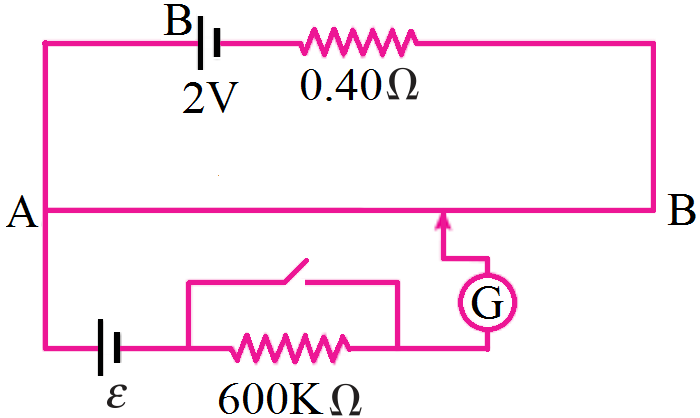
Figure shows a potentiometer with a cell of 2.0V and internal resistance of $0.40\Omega$ maintaining a potential drop across the resistor wire AB. A standard cell which maintains a constant emf of 1.02V (for very moderate currents upto a few mA) gives a balance point at 67.3cm length of the wire. To ensure very low currents drawn from the standard cell, a very high resistance of $600\text{k}\Omega$ is put in series with it, which is shorted close to the balance point. The standard cell is then replaced by a cell of unknown emf and the balance point found similarly, turns out to be at 82.3cm length of the wire.

  1. What is the value of $\varepsilon?$
  2. What purpose does the high resistance of $600\text{k}\Omega$ have?
  3. Is the balance point affected by this high resistance?
  4. Is the balance point affected by the internal resistance of the driver cell?
  5. Would the method work in the above situation if the driver cell of the potentiometer had an emf of 1.0V instead of 2.0V?
  6. Would the circuit work well for determining extremely small emf, say of the order of few mV (such as the typical emf of a thermo couple)? If not, how would you modify the circuit?
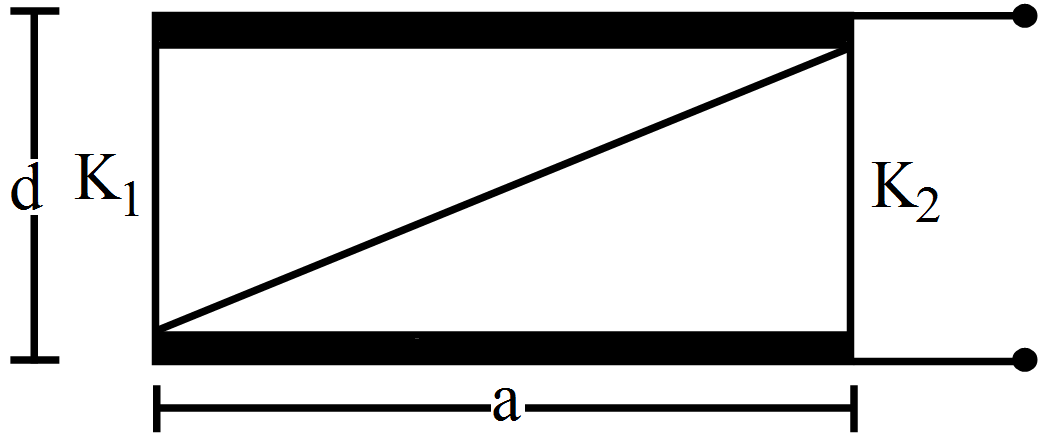
A capacitor is formed by two square metal-plates of edge a, separated by a distance d. Dielectrics of dielectric constants K1 and K2 are filled in the gap as shown in figure. Find the capacitance.

a. Derive an expression for the impedance of a series L-C-R circuit connected to an AC supply of variable frequency.
b. Explain briefly how the phenomenon of resonance in the circuit can be used in the tuning mechanism of a radio or a TV set?
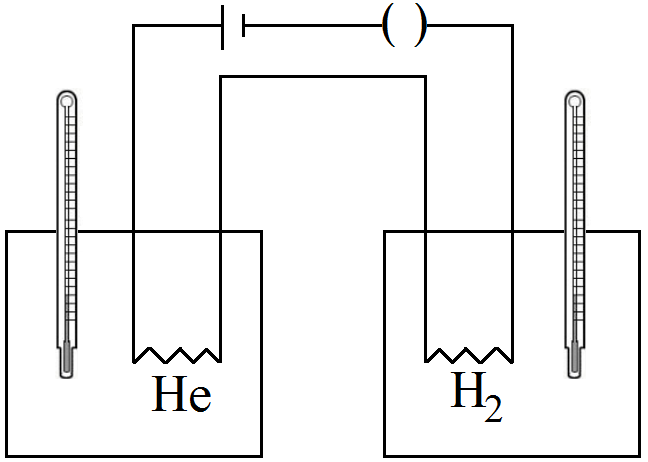
The figure shows two vessels with adiabatic walls, one containing 0.1g of helium $\big(\gamma=1.67,\text{M}=4\text{g-mol}^{-1}\big)$ and the other containing some amount of hydrogen $\big(\gamma=1.4,\text{M}=2\text{g-mol}^{-1}\big).$ Initially, the temperatures of the two gases are equal. The gases are electrically heated for some time during which equal amounts of heat are given to the two gases. It is found that the temperatures rise through the same amount in the two vessels. Calculate the mass of hydrogen.

The work function of a photoelectric material is 4.0eV.
  1. What is the threshold wavelength?
  2. Find the wavelength of light for which the stopping potential is 2.5V.