Question
Write the three laws given by Kepler. How did they help Newton to arrive at the inverse square law of gravity?

Answer

Kepler’s first law :
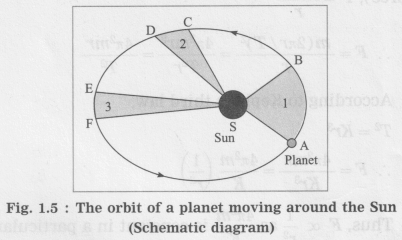
The orbit of a planet is an ellipse with the Sun at one of the foci.
Maharashtra Board Class 10 Science Solutions Part 1 Chapter 1 Gravitation 1
Figure $1.5$ shows the elliptical orbit of a planet revolving around the Sun $(S)$.Kepler’s second law :
The line joining the planet and the Sun sweeps equal areas in equal intervals of time.
$A \rightarrow B, C \rightarrow D$ and $E \rightarrow F$ are the displacements of the planet in equal intervals of time.
The straight lines $AS, CS$ and ES sweep equal areas in equal intervals of time.
Area $ASB =$ area $CSD =$ area $ESF.$
Kepler’s third law :
The square of the period of revolution of a planet around the Sun is directly proportional to the cube of the mean distance of the planet from the Sun.
Thus, if r is the average distance of the planet from the Sun and $T$ is its period of revolution, then,
$T^2 ∝ r^2 , i.e.,  \frac{T^{2}}{r^{3}} =$ constant $= K$
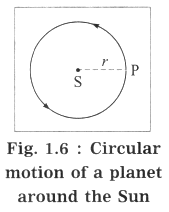
For simplicity, we shall assume the orbit to be a circle.
Maharashtra Board Class 10 Science Solutions Part 1 Chapter 1 Gravitation 2
In Fig. $1.6,$
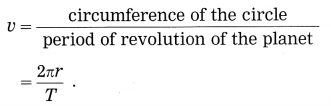
S denotes the position of the Sun, P denotes the position of a planet at a given instant and r denotes the radius of the orbit (= the distance of the planet from the Sun). Here, the speed of the planet is uniform.
Maharashtra Board Class 10 Science Solutions Part 1 Chapter 1 Gravitation 3
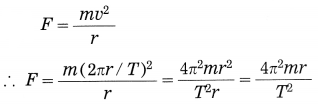
If m is the mass of the planet, the centripetal force exerted on the planet by the Sun (= gravitational force),
Maharashtra Board Class 10 Science Solutions Part 1 Chapter 1 Gravitation 4
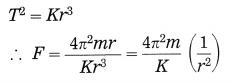
According to Kepler’s third law,
Maharashtra Board Class 10 Science Solutions Part 1 Chapter 1 Gravitation 5
Thus, $F ∝ \frac{1}{r^{2}}$ as $\frac{4 \pi^{2} m}{K}$ is constant in a particular case.

Need a full question paper?

Generate a complete, print-ready paper with questions like this in minutes — across 16+ boards, with answer keys.
Start Generating Free

Similar questions

Explain the difference between each of the following pairs of terms:
  1. Receptor and effector.
  2. Cerebrum and cerebellum.
The gland X which is located just below the brain in the human head secretes a chemical substance Y which controls the development of ones and muscles in the body of a person. Secretion of too little of substance Y as well as the secretion of too much of substance Y by the gland X leads to abnormal development of the body of a person.
  1. Name the gland X.
  2. What is the chemical substance Y?
  3. What happens if too little of substance Y is secreted?
  4. What happens if too much of substance Y is secreted?
  5. Name the system of glands in the human body of which gland X is a part.
A 2kW heater, a 200W TV and three 100W lamps are all switched on from 6m. to 10p.m. What is the total cost at Rs.5.50per kWh?
What are the possible blood groups likely to be inherited by children born to a group $A$ mother and a group $B$ father? Explain your reasoning.
When a broken piece of the stem of a plant X is planted in the soil, a new plant grows from it in a week's time. The leaves of plant X also have many small entities Y in their margins which can fall to the ground alone or alongwith leaves and grow into new plants.
  1. Name a plant which X could be.
  2. What are the entities Y present on the leaves of X known as?
  3. Name a plant other than X which can be reproduced from its leaves.
  4. Name a common plant grown in many homes which can be propagated from its broken stems like plant X.
  5. Name a kind of dormant organs present in dry stems of old grass plants lying in the fields which get activated and produce green grass plants after the rains.
An object is placed 10cm from a lens of focal length 5cm. Draw the ray diagrams to show the formation of image if the lens is:
  1. Converging, and
  2. Diverging.
They are not correct. The father with blood group A has genotype $I^AI^O.$ The mother with blood group $B$ has genotype $I^BI^O.$ Hence, the possible genotypes of the children will be $I^AI^B, I^AI^O, I^BI^O$ and $I^OI^O$. Thus, the possible blood groups of children will be $AB, A, B$ and $O.$ Hence, if the father has blood group A, and the mother has blood group $B, $ it is possible for them to have children with blood group O.
An object is placed vertically at a distance of 20 cm from a convex lens. If the height of the object is 5 cm and the focal length of the lens is 10 cm, what will be the position, size and nature of the image? How much bigger as compared to the object?
What is menstrual cycle? Describe it in brief.
 Explain the importance of good communication with others.