Question
Write ‘True’ or ‘False’ and justify your answer.
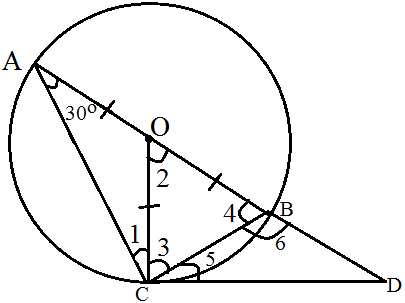
AB is a diameter of a circle and AC is its chord such that $\angle\text{BAC}=30^\circ.$ If the tangent at C intersects AB extended at D, then BC = BD.
Answer

True.

CD is a tangent at contact point C. AOB is diameter which meets tangent produced at D.
Chord AC makes $\angle\text{A}=30^\circ$ with diameter AB.
To prove BD = BC
Proof: In $\triangle\text{OAC},$
OA = OC = r [Radil of same circle]
$\angle1=\angle\text{A}$ $[\angle\text{s}$ opp. to equal sides are equal$]$
$\Rightarrow\ \angle1=30^\circ\ \ [\because\angle\text{A}=30^\circ]$
Exterior $\angle\text{BOC}=\angle2=\angle1+\angle\text{A}=(30^\circ+30^\circ)=60^\circ$
Now, in $\triangle\text{OCB},$
OC = OB [Radii of same circle]
$\therefore\ \angle3=\angle4$ [Angles opposite to equal sides are equal]
$\angle3+\angle4+\angle\text{COB}=180^\circ$
$\Rightarrow\ \angle3+\angle3+60^\circ=180^\circ$ [Angle sum property of triangle]
$\Rightarrow\ 2\angle3=180^\circ-60^\circ=120^\circ$
$\Rightarrow\ \angle3=60^\circ=\angle4$
$\angle6+\angle4=180^\circ$ [Linear pair axiom]
$\Rightarrow\ \angle6=180^\circ-\angle4$
$=180^\circ-60^\circ$
$\Rightarrow\ \angle6=120^\circ$
$\because$ Tangent CD and radius CO are at contact point C.
$\therefore\ \angle\text{OCD}=90^\circ$
$\Rightarrow\ \angle3+\angle5=90^\circ$
$\Rightarrow\ 60^\circ+\angle5=90^\circ$
$\Rightarrow\ \angle5=30^\circ$
Now, in $\triangle\text{BCD},$ we have
$\angle\text{D}+\angle5+\angle6=180^\circ$ [Angle sum property of a triangle]
$\Rightarrow\ \angle\text{D}=180^\circ-\angle5-\angle6$
$=180^\circ-30^\circ-120^\circ=180^\circ-150^\circ$
$\Rightarrow\ \angle\text{D}=30^\circ$
$\therefore\ \angle\text{D}=\angle5=30^\circ$
$\Rightarrow\text{BC}=\text{BD}$
[Sides opposite to equal $\angle\text{s}$ of a triangle are equal]
Hence, verifies the given statement true.

Need a full question paper?

Generate a complete, print-ready paper with questions like this in minutes — across 16+ boards, with answer keys.

Start Generating Free

Similar questions

Two sides and the perimeter of one triangle are respectively three times the corresponding sides and the perimeter of the other triangle. Are the two triangles similar? Why?
Are the following statements 'True' or 'False'? Justify your answers.
If the graph of a polynomial intersects the x-axis at only one point, it cannot be a quadratic polynomial.
Write ‘True’ or ‘False’ and justify your answer.
The length of tangent from an external point P on a circle with centre O is always less than OP.
Write whether the following statements are true or false. Justify your answers.
Every quadratic equation has exactly one root.
Write the truth value (T/F) of the following statements:
Two polygons are similar, if their corresponding angles are proportional.
Write ‘True’ or ‘False’ and justify your answer.
If a man standing on a platform 3 metres above the surface of a lake observes a cloud and its reflection in the lake, then the angle of elevation of the cloud is equal to the angle of depression of its reflection.
Are the following statements 'True' or 'False'? Justify your answers.
If all three zeroes of a cubic polynomial $x^3+a x^2-b x+c$ are positive, then at least one of $a, b$ and $c$ is non-negative.
In covering a distance s metres, a circular wheel of radius r metres makes $\frac{\text{s}}{2\pi\text{r}}$ revolutions. Is this statement true? Why?
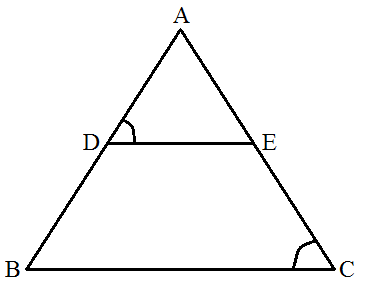
If $\angle\text{D}=\angle\text{C},$ then is it true that $\triangle\text{ADE}\sim\triangle\text{ACB}?$ Why?
Are the following statements 'True' or 'False'? Justify your answers.
If the graph of a polynomial intersects the x-axis at only one point, it cannot be a quadratic polynomial.