Question
Write two applications of electrochemical series.

Answer

I. Predicting the Liberation of Hydrogen Gas from Acids by Metals : All metals having negative electrode potentials (negative $E _{\text {red }}^0$ ) show greater tendency of losing electrons as compared to hydrogen. So, when such a metal is placed in an acid solution, the metal gets oxidised, and $H ^{+}$ions get reduced to form hydrogen gas. Thus the metals having negative $E _{ red }^0$ values liberate hydrogen from acid solution.
$M \longrightarrow M _{(a q)+n e^{-}}^{n+}$
Metal having negative $E _{\text {red }}^{\circ}$ value
Thus, $\quad n H _{(a q)}^{+}+n e^{-} \longrightarrow n / 2 H _{2(g)}$
$M +n H _{(a q)}^{+} \longrightarrow M _{(a q)}^{n+}+\frac{n}{2} H _{2(g)}$
In other words, we can say that metals which are placed above hydrogen in electro-chemical series liberate hydrogen from acids while the metals which are below hydrogen in the electro-chemical series (like $Cu , Hg , Au$, Pt etc.) do not evolve hydrogen from acids, as they have positive value of electrode reduction potential.
II. Predicting the Displacement of Metals : A metal higher in the series will displace the metal from its solution which is lower in the series i.e., the metal having low standard reduction potential will displace the metal from its salt solution which has higher value of standard reduction potential. This is due to the fact that the metal having more negative value of $E _{\text {red }}^0$ have a higher tendency to lose electrons. Thus, having a greater tendency to dissolve in solution as cations. The ions of another metal having higher $E _{\text {red }}^0$ value show a greater tendency towards reduction.
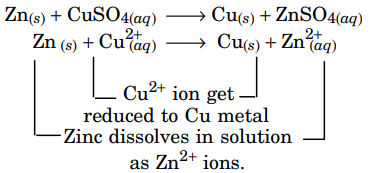
Example : Zinc displaces copper from $CuSO _4$
Solution
$Zn _{(s)}+ CuSO _{4(a q)} \longrightarrow Cu _{(s)}+ ZnSO _{4(a q)}$
or
Image
The $E _{ red }^0$ of $Zn =-0.76 V$ and for $Cu =+0.34 V$.
Zn has lower $E ^0$ value as compared to $Cu . Zn$ has greater tendency towards oxidation and $Cu ^{2+}$ ions get reduced to Cu metal.
$Zn \longrightarrow Zn ^{2+}+2 e^{-}$ $\quad$(Oxidation)
$Cu ^{2+}+2 e^{-} \longrightarrow Cu$$\quad$(Reduction)
Thus, Low displaces or reduces high
Similarly, copper displaces silver from $AgNO _3$ solution or iron can displace copper from $CuSO _4$ but silver does not displace copper.

Need a full question paper?

Generate a complete, print-ready paper with questions like this in minutes — across 16+ boards, with answer keys.
Start Generating Free

Similar questions

  1. Explain the following:
  1. Henry's law about dissolution of a gas in a liquid.
  2. Boiling point elevation constant for a solvent.
  1. A solution of glycerol $(C_3H_8O_3)$ in water was prepared by dissolving some glycerol in $500 g$ of water. This solution has a boiling point of $100.42^\circ C.$ What mass of glycerol was dissolved to make this solution? $(K_b$ for water $= 0.512 K \ kg\ mol^{–1}).$
  1. Describe the general trends in the following properties of the first series of the transition elements:
  1. Stability of +2 oxidation state.
  2. Formation of oxometal ions.
  1. Assign reason for each of the following:
  1. Transition elements exhibit variable oxidation states.
  2. Transition metal ions are usually coloured.
Write the $\text{IUPAC}$ names of the following coordination compounds:
$a.\ \left[ Pt \left( NH _3\right)_2 Cl \left( NO _2\right]\right.$
$b.\ K _3\left[ Cr \left( C _2 O _4\right)_3\right]$
$c.\ \left[ CoCl _2( en )_2\right] Cl$
$d.\ \left[ Co \left( NH _3\right)_5\left( CO _3\right)\right] Cl$
$e.\ Hg \left[ Co ( SCN )_4\right]$
Answer the following questions:
Give chemical reactions for the following observations:
  1. Potassium permanganate is a good oxidising agent in basic medium.
  2. Inter convertibility of chromate ion and dichromate ion in aqueous solution depends upon pH of the solution.
  3. Potassium permanganate is thermally unstable at 513K.
How to determine the vapour pressure and total pressure of the components in binary solution of two volatile liquids? Explain their mathematical form and also explain the graph between mole fraction and vapour pressure for an ideal solution.
  1. With reference to structural variability and chemical reactivity, write the differences between lanthanoids and actinoids.
  2. Name a member of the lanthanoid series which is well known to exhibit $+4$ oxidation state.
  3. Complete the following equation:
$\text{MnO}_{4}^{-}+\text{8H}^{+}+\text{5e}^{-}\rightarrow$
  1. Out of $Mn^{3+}$ and $Cr^{3+}$, which is more paramagnetic and why?
$($Atomic nos: $Mn = 25, Cr = 24).$
What happens when:
(a) Propene is passed into concentrated $H _2 SO _4$ and the product is boiled with water.
(b) Methoxy ethane is heated with HI.
(c) Ethanol is heated with Fenton's reagnet.
(d) Toluene is heated with Chromyl Chloride in $CS _2$ and the product is hydrolysed.
(e) Crotonaldehyde is treated with $LiAH _4 / dry$ ether and the product is acid hydrolysed.
Derive formula for degree of dissociation and degree of condensation of the solute in the solvent.
Answer the following questions: Is the variability in oxidation number of transition elements different from that of non$-$transition elements? Illustrate with examples.
What is vapour pressure? When a non- volatile solute is dissolved in any liquid, the vapour pressure of the liquid decreases. Give reason.