Question
Write two differences between charge and mass.

Answer

(1) Charge can be zero, positive or negative but mass is always positive.
(ii) Electric charge does not depend on the velocity of motion of the particle whereas mass also depends on the velocity of motion of the particle.

Need a full question paper?

Generate a complete, print-ready paper with questions like this in minutes — across 16+ boards, with answer keys.
Start Generating Free

Similar questions

Define trans conductance of a transistor.
An electric dipole is placed inside a closed surface, whose dipole moment is $20 \times 10^{-6}$ coulomb-meter. What will be the electric flux emerging out of this surface?
In the decay 64Cu → 64Ni + e+ + v, the maximum kinetic energy carried by the positron is found to be 0.650MeV.
  1. What is the energy of the neutrino which was emitted together with a positron of kinetic energy 0.150MeV?
  2. What is the momentum of this neutrino in kg-m/s?
Use the formula applicable to a photon.
An electric dipole of dipole moment 20 × 10-6C is enclosed by closed surface. What is the net electric flux coming out of this surface?
The electric field E due to any point charge near it is defined as $\text{E}=\lim\limits_{\text{q}\rightarrow0}\frac{\text{F}}{\text{q}}$ where q is the test charge and F is the force acting on it. What is the physical significance of $\lim\limits_{\text{q}\rightarrow0}$ in this expression?
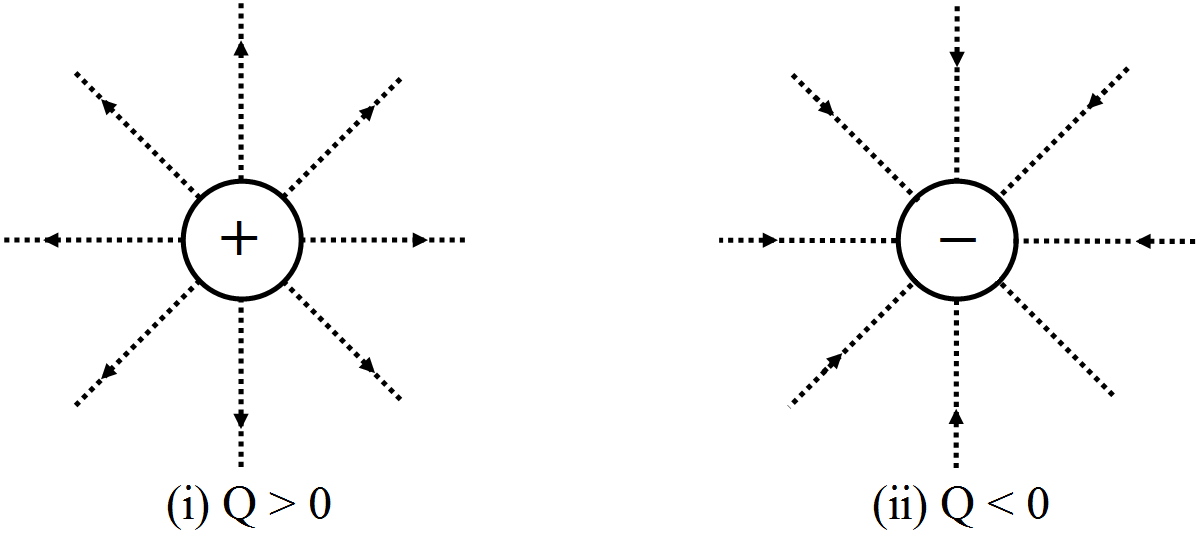
Draw the electric lines of point charge Q when,
  1. Q > 0
  2. Q < 0.

A beam of protons with a velocity $4 \times 10^5 m / s$ enters a uniform magnetic field of 0.3 T at an angle $60^{\circ}$ to the magnetic field. Find the radius of the helical path taken by the proton beam. Also find the pitch of the helix mp $=1.67 \times 10^{-27} k$
Explain Rutherford's nuclear model of the atom.
The gravitational field in a region is given by $\text{E}=(2\hat{\text{i}}+3\hat{\text{i}})\text{N/kg}.$ Show that no work is done by the gravitational field when a particle is moved on the line 3y + 2x = 5.
Hint: If a line y = mx + c makes angle $\theta$ with the X-axis, m $=\tan\theta$
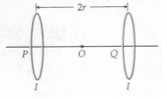
Two identical circular loops, P and Q. each of radius r and carrying currents are kept in the parallel planes having a common axis passing through O. The direction of current in P is clockwise and in Q is anti-clockwise as seen from O which is equidistant from the loops P and Q. Find the magnitude of the net magnetic field at O.

Image
Draw magnetic field lines when a (i) diamagnetic, (ii) paramagnetic substance is placed in an external magnetic field. Which magnetic property distinguishes this behaviour of the field lines due to the two substances?