Question
Write two differences between electromagnet and permanent magnet.

Answer

Electro MagnetPermanent Magnet
1. These can be magne-tised and demagnetised again and again.1. These can not be magnetised and demagnetised again and again.
2. These are made of substances having high magnetic suspectibility and low retentivity e.g. Iron.2. These are made up of sub-stances having high coercitivity and retentivity, e.g. steel or alloys.

Need a full question paper?

Generate a complete, print-ready paper with questions like this in minutes — across 16+ boards, with answer keys.
Start Generating Free

Similar questions

What is reverse bias? Explain the change occuring in the junction under the effect of reverse bias.
In Exercise 4.11 obtain the frequency of revolution of the electron in its circular orbit. Does the answer depend on the speed of the electron? Explain.
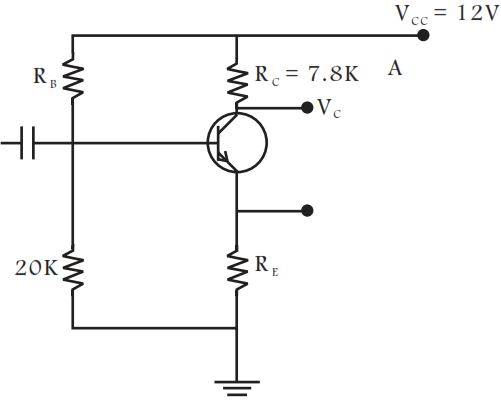
For the transistor circuit shown in Fig, evaluate VE, RB, RE given IC = 1 mA, VCE = 3V, VBE = 0.5 V and VCC = 12 V, β = 100.

A flint glass prism and a crown glass prism are to be combined in such a way that the deviation of the mean ray is zero. The refractive index of flint and crown glasses for the mean ray are 1.620 and 1.518 respectively. If the refracting angle of the flint prism is 6.0°, what would be the refracting angle of the crown prism?
Draw a circuit diagram of a transistor amplifier in CE configuration. Under what condition does the transistor act as an amplifier?
Define the terms:
i. Input resistance and
ii. Current amplification factor. How are these determined using typical input and output characteristics?
Pick up (i) Isotones, (ii) Isotopes, (iii) Isobars among the following:
$ {}_{6}^{12}C, {}_{2}^{3}He, {}_{80}^{198}Hg, {}_{1}^{3}H, {}_{79}^{197}Au, {}_{6}^{14}C $.
The ground state energy of hydrogen atom is is - 13.6 eV. What are the kinetic and potential energies of the electron in this state?
An experimenter's diary reads as follows: "A charged particle is projected in a magnetic field of $(7.0\vec{\text{i}}-3.0\vec{\text{j}})\times10^{-3}\text{T}.$ The acceleration of the particle is found to be $(\vec{\text{i}}+7.0\vec{\text{j}})\times10\text{m/s}^{2\text{n}}.$ The number to the left of $\vec{\text{i}}$ in the last expression was not readable. What can this number be?
For a normal eye, the far point is at infinity and the near point of distinct vision is about 25 cm in front of the eye. The cornea of the eye provides a converging power of about 40 dioptres, and the least converging power of the eye-lens behind the cornea is about 20 dioptres. From this rough data estimate the range of accommodation (i.e., the range of converging power of the eye-lens) of a normal eye.
A radioactive isotope is being produced at a constant rate $\frac{\text{dN}}{\text{dt}}=\text{R}$ in an experiment. The isotope has a half-life $\text{t}_{\frac{1}2{}}.$ Show that after a time $\text{t}>>\text{t}_{\frac{1}{2}},$ the number of active nuclei will become constant. Find the value of this constant.