Question
Write two differences between spermatogenesis and oogenesis.

Answer

S. No. Spermatogenesis Oogenesis
(i)
It is the process of formation of haploid spermatozoa from diploid male germ cells of the testes.
It is the process of formation of haploid ova from the gamete mother cells (oogonia) in the ovary.
(ii)
It occurs in testes.
It occurs in ovaries.
(iii)
A primary spermatocyte divides to form two secondary spermatocytes by meiosis I.
A primary oocyte divides by meiosis I to form one secondary oocyte and a polar body.
(iv)
Spermatogonia changes to primary spermatocyte.
Oogonia changes to primary oocyte.
(v)
A secondary spermatocyte divides to form two spermatids by meiosis II.
A secondary oocyte divides by meiosis II to form ovum and a polar body.
(vi)
No polar body is formed.
Polar bodies are formed.
(vii)
Four spermatozoa are produced from one primary spermatocyte.
One ovum/ egg is produced from one primary oocyte.

Need a full question paper?

Generate a complete, print-ready paper with questions like this in minutes — across 16+ boards, with answer keys.

Start Generating Free

Similar questions

Match the codons in Column I with the amino acids in Column II.
S. No.
Column I
 
Column II
A
UUU
1
Termination
B
AUG
2
Tyrosine
C
UAA
3
Phenylalanine
D
AGU
4
Methionine
E
UAC
5
Serine
Following is the sequence of nucleotide in two strands of DNA. Observe the strands and answer the preceding questions.
5' - GAATTC - 3'
3' - CTTAAG - 5'
  1. Name the special term used for such an arrangement of nucleotide.
  2. Name the special type of enzymes which work/ function at this specific points.
  3. Name the enzyme, that cut DNA between GA sequence.
  4. Name the single strands produced after the action of the enzyme.
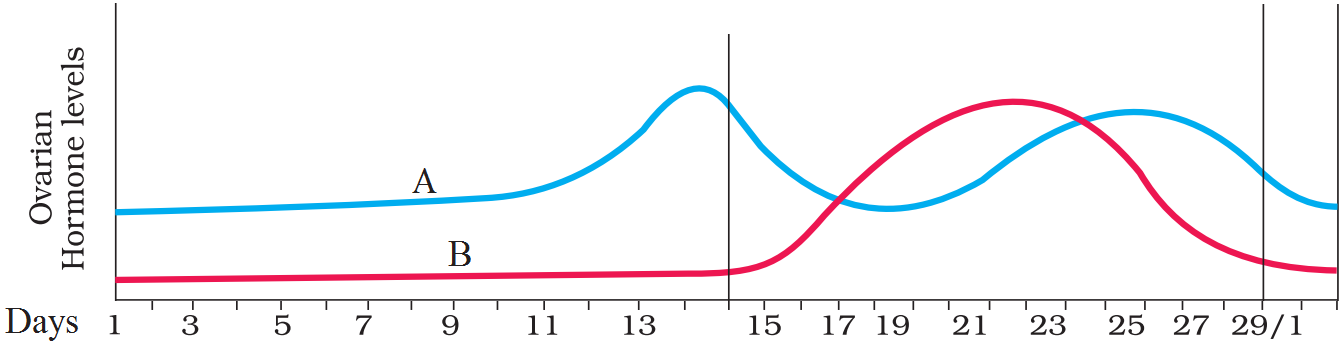
The graph given below shows the variation in the levels of ovarian hormones during various phases of menstrual cycle:

Reason out why A peaks before B.

List the components of the embryo sac and mention their fate on fertilisation.

OR

Mention the fate of all the components of the embryo sac after fertilisation.

“Microbes play a dual role when used for sewage treatment as they not only help to retrieve usable water but also generate fuel”. Explain.
Which methodology is used while sequencing the total DNA from a cell? Explain it in detail.
The following is the illustration of the sequence of ovarian events (a – i) in a human female.

Write the difference between ‘c’ and ‘h’.

  1. Explain the phenomenon of multiple allelism and co-dominance taking ABO blood group as an example,
  2. What is the phenotype of the following:
  1. IAi
  2. ii
  1. A garden pea plant bearing terminal, violet flowers, when crossed with another pea plant bearing axial, violet flowers produced axial, violet flowers and axial, white flowers in the ratio of 3 : 1. Work out the cross showing the genotypes of the parent pea plants and their progeny.
  2. Name and state the law that can be derived from this cross and not from a monohybrid cross.
Read the following and answer any four questions from (i) to (v) given below:

Gene therapy is the technique of genetic engineering to replace a faulty gene by a normal healthy functional gene. It is a way of treating genetic disease by introducing a piece of DNA into the cells of an affected individual. Liposomes can be used for gene therapy as they target the cells affected by a genetic disease.

  1. A patient suffers from adenosine deaminase (ADA) deficiency, an autosomal recessive immune deficiency in which bone marrow lymphoblasts cannot replicate to generate immuno-competent lymphocytes. The treatment option that would cure the patient is:
  1. Germ-line gene therapy to replace one ADA gene copy.
  2. Germ-line gene therapy to replace both ADA gene copies.
  3. Somatic cell gene therapy to replace both ADA gene copies in circulating lymphocytes.
  4. Somatic cell gene therapy to replace one ADA gene copy in bone marrow lymphoblasts.
  1. Which type of gene therapy is least effective in transferring DNA to the nucleus?
  1. Adenoviruses.
  2. DNA attached to a ligand.
  3. Liposomes.
  4. Retroviruses.
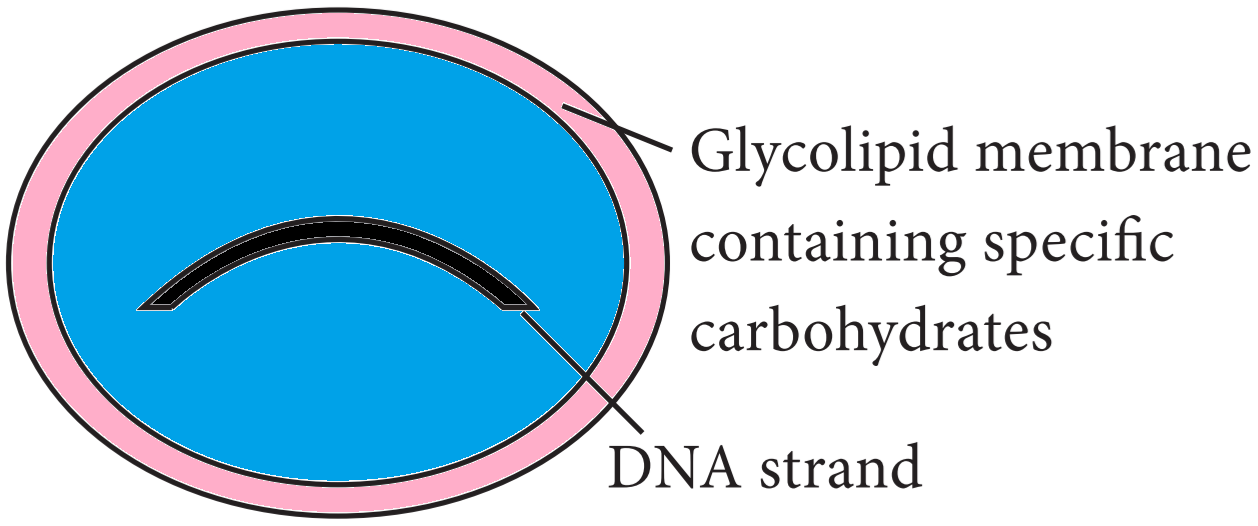
  1. Liposomes can be used for gene therapy as they target the cells affected by a genetic disease. The diagram shows the structure of a liposome.

What feature of a cell surface membrane allows the liposome to target cells affected by a genetic disease? 

  1. Carrier molecules.
  2. Phosphate groups.
  3. Protein channels.
  4. Receptor molecules.
  1. Which of the following disorders would gene therapy be least effective?
  1. Cystic fibrosis.
  2. Huntington's disease.
  3. Sickle cell anaemia.
  4. Type II diabetes.
  1. Following are some reasons explaining why gene therapy is not yet fully an effective treatment for genetic diseases.
  1. Lack of knowledge of DNA sequences.
  2. Lack of efficient and safe gene delivery system.
  3. Cost of the technology.
  4. Some diseases involve multiple genes.
  5. Problems with appropriate gene regulation.

Select the correct option. 

  1. I, III and V only
  2. II, IV and V only
  3. Ill, IV and V only
  4. I, III and IV only