Question
  1. Write two main observations of photoelectric effect experiment which could only be explained by Einstein’s photoelectric equation.
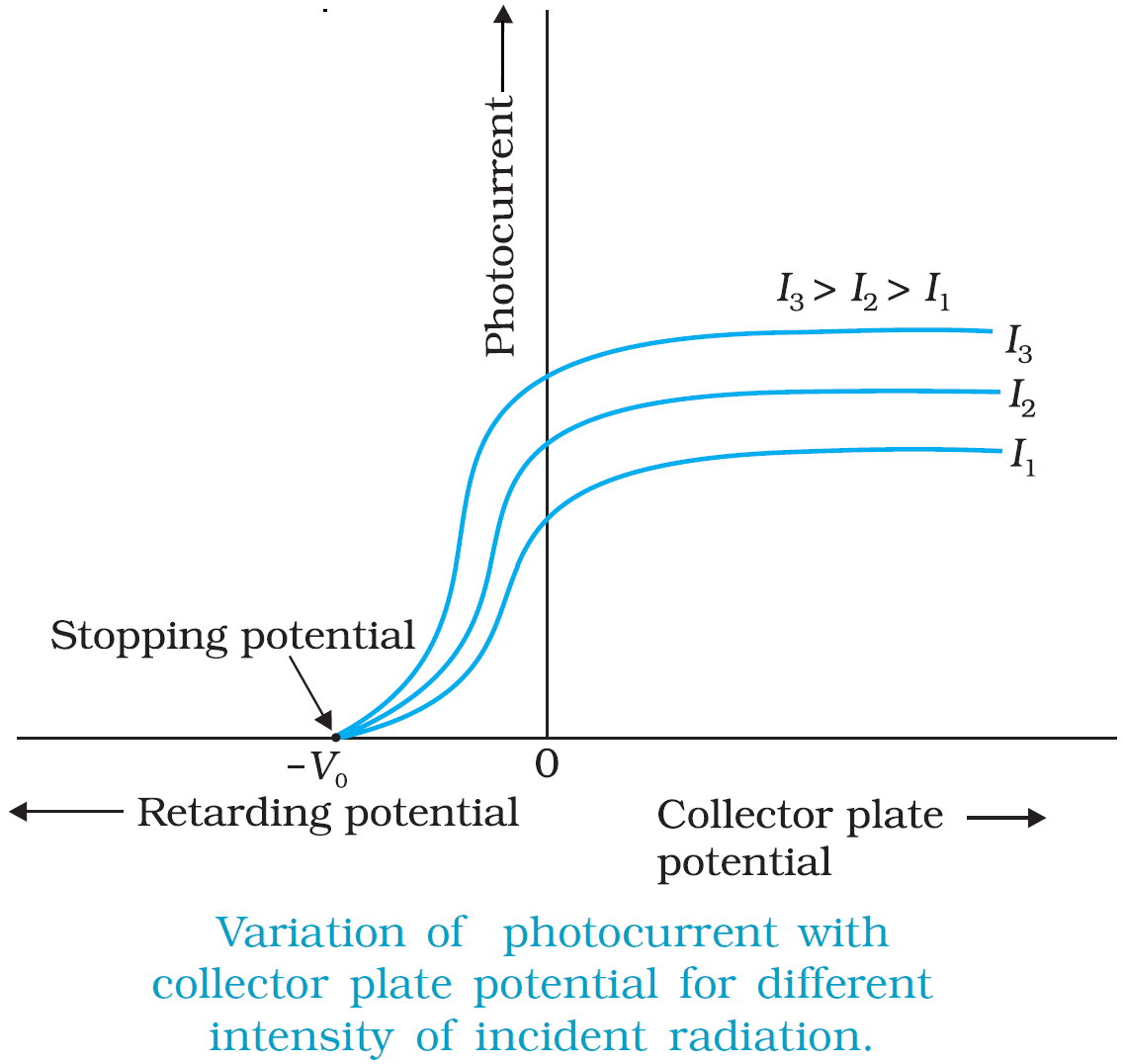
  2. Draw a graph showing variation of photocurrent with the anode potential of a photocell.
Answer

  1.  
  1. There exists a threshold frequency below which no photoelectron is ejected.
  2. KE of electron depends linearly on frequency and is independent of intensity of radiation.
  1.  

[only curve is essential to draw]

Need a full question paper?

Generate a complete, print-ready paper with questions like this in minutes — across 16+ boards, with answer keys.
Start Generating Free

Similar questions

Can you ever have a situation in which a light ray goes undeviated through a prism?
Explain about super conductor materials with respect to their magnetic properties.
What is stationary interference? How can we get, the resultant intensity of super position of waves emanated from the incoherent sources?
How does the power of a convex lens vary, if the incident red light is replaced by violet light?
A simple microscope using a single lens often shows coloured image of a white source. Why?
Write briefly the underlying principle used in Davison-Germer experiment to verify wave nature of electrons experimentally. What is the de-Broglie wavelength of an electron with kinetic energy (of).120 ev? Write briefly the underlying principle used in Davison-Germer experiment to verify wave nature of electrons experimentally. What is the de-Broglie wavelength of an electron with kinetic energy (of).120 ev?
A 5 m long straight horizontal conducting wire situated in the east to west direction is falling with a speed of $2 m / s$ perpendicular to the horizontal component of the earth magnetic field of $0.3 \times 10^{-4} T$. Find the instantaneous value of the emf induced between the ends of the wire.
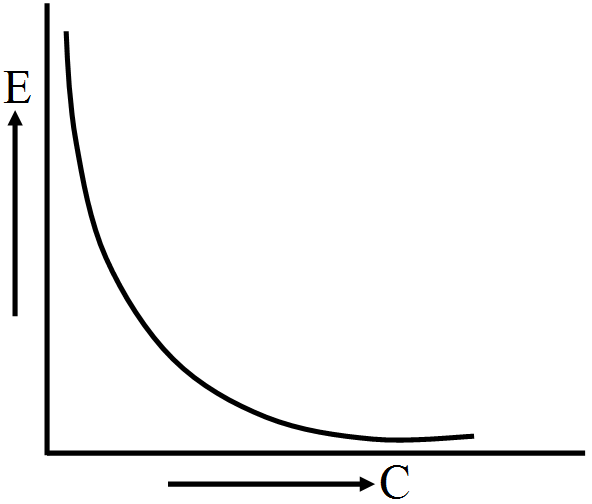
The graph shown here shows the variation of total energy (E) stored in a capacitor against the value of the capacitance (C) itself. Which of the two: the charge on capacitor or the potential used to charge it, is kept constant for this graph?

Provide the classification of semi-conductors with example.
A cylindrical surface of radius $r$ and length $l$ contains a thin, straight conducting wire of charge density $\lambda$ of infinite length. The axis of the cylindrical surface coincides with the length of the wire. Find the expression for electric flux through a cylindrical surface.