MCQ
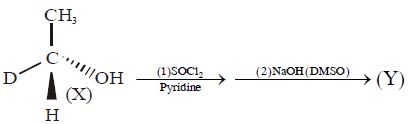
$(X)$ and $(Y)$ are
  • A
    Structure isomers
  • B
    Enantiomers
  • C
    Different compounds
  • Identical compounds

Answer

Correct option: D.
Identical compounds
d
Inversion in configuration takes place in both steps so identical product will obtain

Need a full question paper?

Generate a complete, print-ready paper with questions like this in minutes — across 16+ boards, with answer keys.
Start Generating Free

Similar questions

Assertion : Hydrolysis of sucrose is known as inversion of cane sugar.
Reason : Sucrose is a disaccharide.
In which of the following species the bonds are non-directional?
Product is
Which of the following principles/rules limits the maximum number of electrons in an orbital to two
Among the following free radical bromination reactions, select those in which $2^o$ halide is the major product
The degree of dissociation of $PCl_5(g)$ at $16.8\ bar$ and $127\,^oC$ is $0.4$ . The value of $K_p$ for the reaction 

$PC{l_5}(g) \rightleftharpoons PC{l_3}(g) + C{l_2}(g)$ is

Octane number can be changed by
Determine enthalpy of formation for $H_2O_2(l)$, using listed enthalpies of reaction

${N_2}{H_4}\left( l \right) + 2{H_2}{O_2}\left( l \right) \to \mathop {{N_2}\left( g \right) + 4{H_2}O\left( l \right);}\limits_{{\Delta_r} H_1^o =  - 818\,kJ/mol} $

${N_2}{H_4}\left( l \right) + {O_2}\left( g \right) \to \mathop {{N_2}\left( g \right) + 2{H_2}O\left( l \right);}\limits_{{\Delta _r}H_2^o =  - 622\,kJ/mol} $

${H_2}\left( g \right) + \frac{1}{2}{O_2}\left( g \right) \to \mathop {{H_2}O\left( l \right);}\limits_{{\Delta _r}H_3^o =  - 285\,kJ/mol} $

.......$kJ/mol$

A solutivn is prepared by mixing $8.5\,g$ of $CH_2Cl_2$ and $11.95\,g$ of $CHCl_3$ . If vapour pressure of $CH_2Cl_2$ and $CHCl_3$ at $298\,K$ are $415$ and $200\, mm\,Hg$ respectively, the mole fraction of $CHCl_3$ in vapour form is : (Molar mass of $Cl\, = 35.5\, g\, mol^{-1}$ )
During compression of a spring the work done is $10\,kJ$ and $2\,kJ$ escaped to the surroundings as heat. The change in internal energy, $\Delta U$ (in $kJ$) is