MCQ
 $(X)$ $\&$ $(Y)$ are
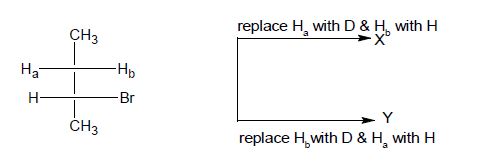
  • A
    Enantiomers
  • Diastereomers
  • C
    $E$ $\&$ $Z$ isomer
  • D
    Constitutional isomer 

Answer

Correct option: B.
Diastereomers
b
Stereomers are not mirror images

Need a full question paper?

Generate a complete, print-ready paper with questions like this in minutes — across 16+ boards, with answer keys.

Start Generating Free

Similar questions

Propan-1-ol and propan-2-ol are examples of :
Which compound on reductive ozonolysis produces at least one mole of $CO_2$ ?
Benzene $ + \,\begin{array}{*{20}{c}}
  {\begin{array}{*{20}{c}}
  {\,\,\,\,\,\,C{H_3}\,\,\,\,\,\,\,\,\,\,\,\,\,\,\,\,\,\,\,\,\,\,\,\,\,\,} \\ 
  {|\,\,\,\,\,\,\,\,\,\,\,\,\,\,\,\,\,\,\,\,\,\,\,\,\,} 
\end{array}\,\,\,\,} \\ 
  {C{H_3} - C - C{H_2} - Cl\xrightarrow{{AlC{l_3}}}} \\ 
  {|\,\,\,\,\,\,\,\,\,\,\,\,\,\,\,\,\,\,\,\,\,\,\,\,\,\,\,\,\,} \\ 
  {C{H_3}\,\,\,\,\,\,\,\,\,\,\,\,\,\,\,\,\,\,\,\,\,\,\,\,} 
\end{array}$  Major product
What will be $C-H$ bond enthalpy if 

$CH_4(g) +2O_2(g)  \rightarrow  CO_2(g)+2H_2O(l)\,;$  $\Delta H= -890 \,kJ$

$CO_2(g)  \rightarrow  C($graphite$) + O_2(g) \,;$   $\Delta H= 393 \,kJ$

$2H_2O(l)  \rightarrow  2H_2(g) + O_2(g) \,;$  $\Delta H= 571 \,kJ$

$2H_2(g) \rightarrow  4H(g)\, ;$  $\Delta H= 871\, kJ$

$C($graphite$)  \rightarrow  C(g)\, ;$  $\Delta H= 716\, kJ$

The bond angles of $NH_3, NH_4^+$ and $NH_2^-$ are in the order :-
${H_2}{C_2}{O_4}$ $\xrightarrow{\Delta }$ gas $(A)$ + gas $(B)$ + liquid $(C)$. 

Gas $(A)$ burns with a blue flame and is oxidised to gas $(B)$

Gas $(A) + Cl_2 \to (D)$

$A, B$ and $D$ are

Which of the following Carbocation will not undergo rearrangement
The nature of bonding in graphite is
If the solubility products of $AgCl$ and $AgBr$ are $1.0 \times {10^{ - 8}}\,M$ and $3.5 \times {10^{ - 13}}$ respectively, then the relation between the solubilities (denoted by the symbol$'S'$) of these salts can correctly be represented as
The present atomic weight scale is based on