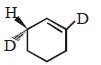
MCQ
$\xrightarrow[\Delta ]{{alc.\,KOH}}$ product
  • A

  • B


  • D

Answer

Correct option: C.

c
It is an example of Anti elimination

Need a full question paper?

Generate a complete, print-ready paper with questions like this in minutes — across 16+ boards, with answer keys.

Start Generating Free

Similar questions

$(Z )-2$ -Butene reacts with $Br_2/H_2O$. The resulting bromohydrin when  treated with methoxide in methanol undergoes an intramolecular $S_{N^2}$ reaction. Taking into consideration the stereochemical consequences of the  reaction mechanism involved, choose the final product $(s)$ of these  transformations.
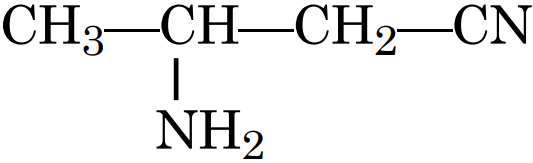
IUPAC name of following compound is

Image
In the following electron dot structure, correct calculation of the formal charge from left to right nitrogen atom is $\overset{\,\,\,\centerdot \,\,\centerdot \,\,\,\,\,\,\,\,\,\,\,\,\,\,\,\,\,\,\,\,\,\,}{\mathop{:N=N=}}\,\overset{\centerdot \,\,\centerdot }{\mathop{N}}\,:$
$Ph - COOH + {C_2}{H_5}\mathop O\limits^{18} H \xrightarrow{{Conc.{H_2}S{O_4}}}$ Major product will be
Total number of stereo isomers possible for the given structure:

$Image$

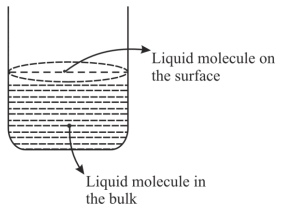
Based on the given figure, the number of correct statement/s is/are $........$.

$A.$ Surface tension is the outcome of equal attractive and repulsion forces acting on the liquid molecule in bulk.

$B.$ Surface tension is due to uneven forces acting on the molecules present on the surface.

$C.$ The molecule in the bulk can never come to the liquid surface.

$D.$ The molecules on the surface are responsible for vapour pressure if the system is a closed system.
For a first order reaction, the rate constant  is $0.04\,\min^{-1}$ at $27\,^oC$ and $0.08\,\min^{-1}$ at $37\,^oC.$ The activation energy of reaction is .......... $kcal /mol$ $(\ln\,2 = 0.7)$
The electrode potentials for

$Cu^{2+}_{(aq)} + e^-\to Cu^+_{(aq)}$ and

$Cu^+_{(aq)} + e^-\to Cu_{(s)}$

are $+0.15\,V$ and $+0.50\,V$ respectively. The value of $E^o_{Cu^{2+}/Cu}$ will be ............ $\mathrm{V}$
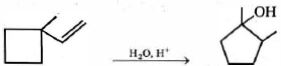
How many transition states and intermediates will be formed during the course of following reaction ?
Which is most acidic of the following