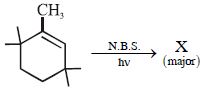
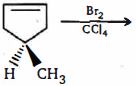
MCQ
$X$ is
  • A


  • C

  • D

Answer

Correct option: B.

b

Need a full question paper?

Generate a complete, print-ready paper with questions like this in minutes — across 16+ boards, with answer keys.

Start Generating Free

Similar questions

An organic compound '$A$' contains nitrogen and chlorine. It dissolves readily in water to give a solution that turns litmus red. Titration of compound '$A$' with standard base indicates that the molecular weight of ' $A$ ' is $131\,\pm\,2$. When a sample of '$A$' is treated with aq. $NaOH$, a liquid separates which contains $N$ but not $Cl$. Treatment of the obtained liquid with nitrous acid followed by phenol gives orange precipitate. The compound '$A$' is.
The reaction, ${H_2}C\mathop { = C{H_2}}\limits_{{\text{Ethylene}}} + \mathop {{H_2}O}\limits_{{\text{water}}} \mathop {\xrightarrow{{{H_3}P{O_4}}}}\limits_{300\,^o C/60\,atm..} \mathop {{C_2}{H_5}OH}\limits_{{\text{Ethyl alcohol}}} $ is called :
Pauli's exclusion principle states that
For a first order reaction, the time required for completion of $90\, \%$ reaction is $'x'$ times the half life of the reaction. The value of $'x'$ is $........\,.$ (Given: $\ln 10=2.303$ and $\log 2=0.3010$ )
$\begin{array}{*{20}{c}}
  {C{H_3} - CH - CH = C{H_2} + HBr \to X\,\left( {major\,product} \right)} \\ 
  {|\,\,\,\,\,\,\,\,\,\,\,\,\,\,\,\,\,\,\,\,\,\,\,\,\,\,\,\,\,\,\,\,\,\,\,\,\,\,\,\,\,\,\,\,\,\,\,\,\,\,\,\,\,\,\,\,\,\,\,\,\,\,\,\,\,\,\,\,\,\,\,\,\,\,\,\,\,\,\,\,\,\,\,\,\,\,\,\,\,\,\,\,\,\,\,\,\,\,\,\,\,\,\,\,\,\,} \\ 
  {C{H_3}\,\,\,\,\,\,\,\,\,\,\,\,\,\,\,\,\,\,\,\,\,\,\,\,\,\,\,\,\,\,\,\,\,\,\,\,\,\,\,\,\,\,\,\,\,\,\,\,\,\,\,\,\,\,\,\,\,\,\,\,\,\,\,\,\,\,\,\,\,\,\,\,\,\,\,\,\,\,\,\,\,\,\,\,\,\,\,\,\,\,\,\,\,\,\,\,\,\,} 
\end{array}$

$X$ is

Wolf kishner reduction, reduces
Most reactive for $S_{N^1}$ reaction is
An alkene, on ozonolysis gives formaldehyde and acetaldehyde. The alkene is :
Which of the following is a carbohydrate
Product/s obtained is/are