MCQ
$X-O-X$ linkage present in $[X = P/S/Cl/Mn]$

$(a) P_2O_7^{4-}$                                           $(b) S_2O_5^{2-}$

$(c) S_2O_7^{2-}$                                            $(d) Cl_2O_7$

$(e) Mn_2O_7$                                         $(f) S_2O_8^{2-}$

  • A
    only $a, \,c,\, d, \,e, \,f$
  • only $a,\, b, \,c, \,e,\, f$
  • C
    only $a, \,c,\, d,\, e$
  • D
    only $a, \,b,\, c, \,d, \,e$

Answer

Correct option: B.
only $a,\, b, \,c, \,e,\, f$
b
The molecular geometry of $BrF_5$ is square pyramidal with asymmetric charge distribution on the central atom.

Need a full question paper?

Generate a complete, print-ready paper with questions like this in minutes — across 16+ boards, with answer keys.

Start Generating Free

Similar questions

Which of the following halogen disproportionates in water ?
$25\,mL$ of $3.0\,M\,HNO_3$ are mixed with $75\,mL$ of $4.0\,M\,HNO_3$. If the volumes are additive, the molarity of the final mixture would be ......... $M$.
Choose correct order of $\Delta {H_{eg}}$ ?

($\Delta {H_{eg}} = e^-$ gain enthalpy)

Considering the above reactions, the compound $'A'$ and compound $'B'$ respectively are
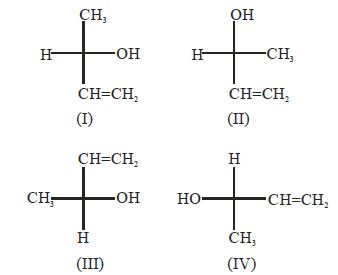
Which of the following combination amongst the four fischer projections represents the enantiomers
Identify from the following species in which $d ^2 sp ^3$ hybridization is shown by central atom:
$Ln$ (Lanthanide) $\xrightarrow{{With{\text{ }}Halogen{\text{ }}}}X$

$Ln$ (Lanthanide) $\xrightarrow{{Burn{\text{ }}With{\text{ }}{{\text{O}}_2}{\text{ }}}}Y$

$Ln$ (Lanthanide) $\xrightarrow{{Heated{\text{ }}with{\text{ }}{{\text{N}}_2}}}Z$

$X,\, Y$ and $Z$ are respectively:-

Two benzyne intermediates are likely to be formed equally. Reaction with amide  ion can occur in two different directions with each benzyne, giving three possible  products. They are formed in a $1 : 2 : 1$ ratio. Asterisk $(^*)$ refers to $^{14}C.$

product $(A)$ is

Zinc can be coated on iron to produce galvanized iron but the reverse is not possible. It is because
For any given series of spectral lines of atomic hydrogen, let $\Delta \bar V\, = \,\Delta {\bar V_{\max }}\, - \,\Delta {\bar V_{\min }}$ be the difference in maximum and minimum frequencies in $cm^{-1}.$ the ration $\Delta {\bar V_{Lymann}}/\,\Delta {\bar V_{Balmer}}$ is