MCQ
$X-O-X$ linkage present in $[X = P/S/Cl/Mn]$

$(a) P_2O_7^{4-}$                                           $(b) S_2O_5^{2-}$

$(c) S_2O_7^{2-}$                                            $(d) Cl_2O_7$

$(e) Mn_2O_7$                                         $(f) S_2O_8^{2-}$

  • A
    only $a, \,c,\, d, \,e, \,f$
  • only $a,\, b, \,c, \,e,\, f$
  • C
    only $a, \,c,\, d,\, e$
  • D
    only $a, \,b,\, c, \,d, \,e$

Answer

Correct option: B.
only $a,\, b, \,c, \,e,\, f$
b
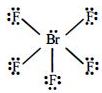
The molecular geometry of $BrF_5$ is square pyramidal with asymmetric charge distribution on the central atom.

Need a full question paper?

Generate a complete, print-ready paper with questions like this in minutes — across 16+ boards, with answer keys.

Start Generating Free

Similar questions

The initial concentration of $R$ in the reaction $R\rightarrow P$ is $4.62 \times 10^{-2} \ce{mol / L}$ What is the half life for the reaction if $k = 2.31 \times 10^{-2} \ce{mol L ^{-1}S^{-1}}$
Which compound is a secondary alcohol?
Nitric acid oxidises phosphorus to
Which compound gives yellow ppt. with iodine and alkali
Number of isomeric primary amines obtained from ${C_4}{H_{11}}N$ are
Given below are two statements:

Statement $I:$ Primary aliphatic amines react with $HNO _{2}$ to give unstable diazonium salts.

Statement $II:$ Primary aromatic amines react with $HNO _{2}$ to form diazonium salts which are stable even above $300 \,K$.

In the light of the above statements, choose the most appropriate answer from the options given below:

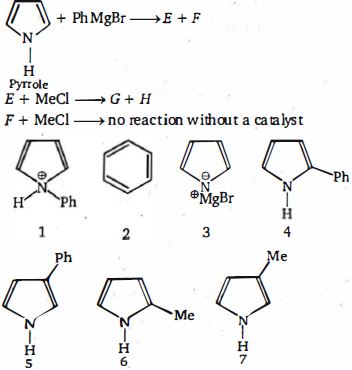
The structure of products $E -H,$ respectively are
The reactions of $Cl _2$ gas with cold-dilute and hot-concentrated $NaOH$ in water give sodium salts to two (different) oxoacids of chlorine, $P$ and $Q$, respectively. The $Cl _2$ gas reacts with $SO _2$ gas, in presence of charcoal, to give a product $R$. $R$ reacts with white phosphours to give a compound $S$. On hydrolysis, $S$ gives an oxoacid of phosphours $T$

$1.$ $P$ and $Q$, respectively, are the sodium salts of

$(A)$ hypochlorus and chloric acids

$(B)$ hypochlorus and chlorus acids

$(C)$ chloric and perchloric acids

$(D)$ chloric and hypochlorus acids

$2.$ $R , S$ and $T$, respectively, are

$(A)$ $SO _2 Cl _2, PCl _5$ and $H _3 PO _4$

$(B)$ $SO _2 Cl _2, PCl _3$ and $H _3 PO _3$

$(C)$ $SOCl _2, PCl _3$ and $H _3 PO _2$

$(D)$ $SOCl _2, PCl _5$ and $H _3 PO _4$

Give the answer question $1$ and $2.$
The lubricating action of an oil is more if it possess
$\pi-$ bonding is not present in