Question
X-rays are known to be electromagnetic radiations. Therefore the X-ray photon has
| (a) Electric charge |
| (b) Magnetic moment |
| (c) Both electric charge and magnetic moment |
| (d) Neither electric charge nor magnetic moment |
X-rays are known to be electromagnetic radiations. Therefore the X-ray photon has
| (a) Electric charge |
| (b) Magnetic moment |
| (c) Both electric charge and magnetic moment |
| (d) Neither electric charge nor magnetic moment |
(d) Neither electric charge nor magnetic moment
Generate a complete, print-ready paper with questions like this in minutes — across 16+ boards, with answer keys.
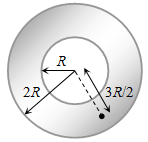
Figure shows the cross-sectional view of the hollow cylindrical conductor with inner radius 'R' and outer radius '2R', cylinder carrying uniformly distributed current along it's axis. The magnetic induction at point 'P' at a distance  from the axis of the cylinder will be
|
(a) Zero |
(b) |
(c) |
(d) |
If 96500 coulombs of electricity liberates one gram equivalent of any substance, the time taken for a current of 0.15 amperes to deposite 20mg of copper from a solution of copper sulphate is (Chemical equivalent of copper = 32)
|
(a) 5 min 20 sec |
(b) 6 min 42 sec |
(c) 4 min 40 sec |
(d) 5 min 50 sec |
What type of lens from the following would you have in your magnifying lens to read a page in small print?
The decay constant of a radioactive element is 1.5  per second. Its mean life in seconds will be
|
(a) 1.5 |
(b) 4.62 |
(c) 6.67 |
(d) 10.35 |


