MCQ
$X-$ rays are produced in laboratory by
  • A
    Radiation
  • B
    Decomposition of the atom
  • Bombardment of high energy electron on heavy metal
  • D
    None of these

Answer

Correct option: C.
Bombardment of high energy electron on heavy metal
c
(c)

Need a full question paper?

Generate a complete, print-ready paper with questions like this in minutes — across 16+ boards, with answer keys.
Start Generating Free

Similar questions

A sample of ideal gas $(\gamma = 1.4)$ is heated at constant pressure. If an $100\, J$ is supplied to gas, the work done by the gas is ...... $J$
Two open organ pipes give $4$ beats/sec when sounded together in their fundamental nodes. If the length of the pipe are $100 cm$ and $102.5 cm$ respectively, then the velocity of sound is  ..... $m/s$
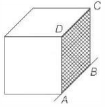
A solid cube of wood of side $2 a$ and mass $M$ is resting on a horizontal surface as shown below. The cube is free to rotate about the fixed axis $A B$. A bullet of mass $m ( < M)$ and speed $v$ is shot horizontally at the face opposite to $A B C D$ at a height $h$ above the surface to impart the cube an angular speed $\omega_{c}$, so that the cube just topples over. Then, $\omega_{c}$ is (Note the moment of inertia of the cube about an axis perpendicular to the face and passing through the centre of mass is $2 M a^{3} / 3$ )
In an adiabatic change, the pressure $P$ and temperature $T$ of a monoatomic gas are related by the relation $P \propto {T^C}$, where $C$ equals
Newton's first law of motion describes the following
Three liquids of equal masses are taken in three identical cubical vessels $A, B$ and $C .$ Their densities are $\rho_{A}, \rho_{B}$ and $\rho_{C} \cdot$ The force exerted by the liquid on the base of the cubical vessel is
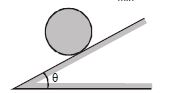
A hollow sphere of mass $m$ filled with a non-viscous liquid of same mass $m$ is released on a slope inclined at angle $q$ with the horizontal. The friction between the sphere and the slope is sufficient to prevent sliding and frictional forces between the inner surface of the sphere and the liquid is negligible. After descending a certain height ratio of translational and rotational kinetic energies is found to be $x:y$, find the numerical value of expression $(x+y)_{min}.$
Two discs of the same material and thickness have radii $0.2\, m$ and $0.6\, m.$  Their moments of inertia about their axes will be in the ratio 
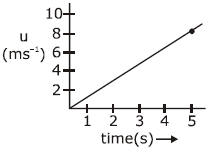
The speed verses time graph for a particle is shown in the figure. The distance travelled (in $m$ ) by the particle during the time interval $t=0$ to $t=5\, s$ will be
Two bodies of masses $2\,kg$ and $4\,kg$ are moving with velocities $2\,m/s$ and $10\,m/s$ respectively towards each other due to mutual gravitational attraction. ....... $m/s$ is the velocity of their centre of mass (Bodies are at rest initially)