MCQ
$x^2- 6x + 6 = 0$ have :
  • A
    Real and Equal roots
  • B
    Real roots
  • Real and Distinct roots
  • D
    No Real roots

Answer

Correct option: C.
Real and Distinct roots
Comparing the given equation to the below equation
$ a x^2+b x+c=0 $
$a=1, b=-6, c=6$
$ D=b^2-4 a c $
$ D=(-6)^2-4 \times 1 \times 6 $
$D = 36 - 24$
$D = 12$
$D > 0.$
If $b^2- 4ac > 0$, then the equation has real and distinct roots
Real and Distinct roots.

Need a full question paper?

Generate a complete, print-ready paper with questions like this in minutes — across 16+ boards, with answer keys.

Start Generating Free

Similar questions

If $p$ and $q$ are the roots of the equation $x^2- px + q + 0,$ then :
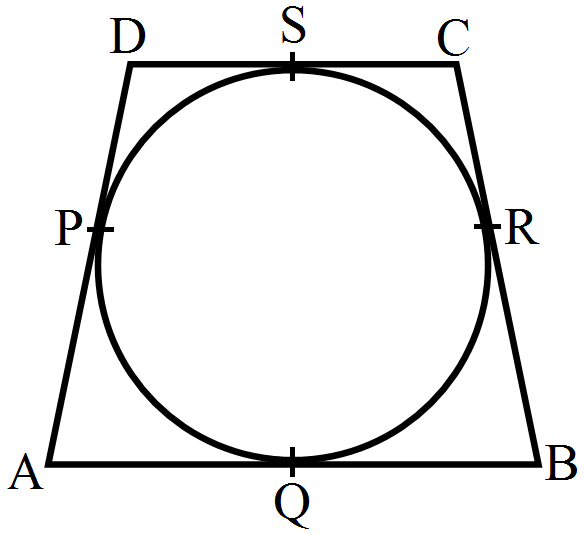
In the given figure, quadrilateral $\text{ABCD}$ is circumscribed, touching the circle at $P, Q, R$ and $S$. If $AP = 5\ cm, BC = 7\ cm$ and $CS = 3\ cm, AB =?$​​​​​​​
In an acute angled triangle $A B C$, if $\sin (A+B-C)=\frac{1}{2}$ and $\cos (B+C-A)=\frac{1}{\sqrt{2}}$. Then masure of angle $B$ is
If a pair linear equations is inconsistent then their graph lines will be:
The angry Arjun carried some arrows for fighting with Bheeshma. With half the arrows, he cut down the arrows thrown by Bheeshma on him and with six other arrows he killed the rath driver of Bheeshma. With one arrow each, he knocked down respectively the rath, flag and bow of Bheeshma. Finally, with one more than four times the square root of arrows, he laid Bheeshma unconscious on an arrow bed. The total number of arrows that Arjun had, is:
The length of the arc of a circle of radius 14 cm which subtends an angle of $60^{\circ}$ at the centre of the circle is:
If $-2$ and $3$ are the zeros of the quadratic polynomial $x^2+(a+1) x+b$, then :
The father’s age is six times his son’s age. Four years later, the age of the father will be four times his son’s age. The present ages, in years, of the son and the father are, respectively :
The positive value of $k$ for which the equation $x^2+ kx + 64 = 0$ and $x^2- 8x + k = 0$ will both have real roots, is :
If $\text{HCF}\ (a, b) = 12$ and $a \times b = 1800, $ then $\text{LCM}\ (a, b$) is :