MCQ
$XeF_6$ on partial hydrolysis gives
  • A
    $XeF_2$
  • $XeOF_4$
  • C
    $XeO_3$
  • D
    $XeOF_2$

Answer

Correct option: B.
$XeOF_4$
b
$Xe{F_6}\xrightarrow[{ - 2HF}]{{ + {H_2}O}}XeO{F_4}$

Need a full question paper?

Generate a complete, print-ready paper with questions like this in minutes — across 16+ boards, with answer keys.
Start Generating Free

Similar questions

Two liquid $A$ and $B$ have vapour pressure in the ratio $P_A^0\,:\,P_B^0\, = \,1\,:\,3$ at a certain temperature. If the ratio of mole fractions of $A$ to $B$ in the vapour phase is $4 : 3$ , then the mole fraction of $B$ in the solution at the same temperature is
Image
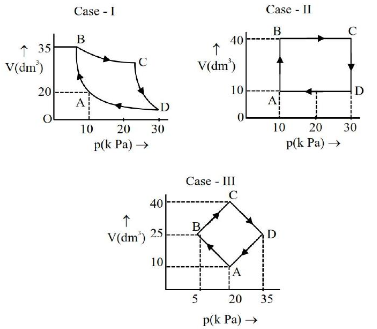
An ideal gas undergoes a cyclic transformation starting from the point A and coming back to the same point by tracing the path $\mathrm{A} \rightarrow \mathrm{B} \rightarrow \mathrm{C} \rightarrow \mathrm{D} \rightarrow \mathrm{A}$ as shown in the three cases above.
Choose the correct option regarding $\Delta \mathrm{U}$.
In which compound, the oxidation state of phosphorus is $+4$
Which of the following sets of reagents, used in the order shown, would be enable for the preparation of $p-$ chlorophenol from $p-$ chloronitrobenzene ?
Which of the following aqueous solution will result maximum number of moles of metal deposited on passing same charge ?
A substance containing an equal number of primary, secondary and tertiary carbon atoms is:
For the reaction, $A(g) + 2B(g) \rightleftharpoons 2C(g)$ at $25\,^oC, 2 \,moles$ of $A, 1\, mole$ of $B$ and $1\, mole$ of $C$ are present in $1$ litre vessel if $K_c$ for the reaction is $2$, then reaction will proceed in
The ionization enthalpy of hydrogen atom is $1.312 \times 10^6\, J\, mol^{-1}.$ The energy required to excite the electron in the atom from $n= 1$ to $n=2$ is
The most stable carbocation among the following is :
If at $298\, K$  the bond energies of $C - H,\,C - C,$ $C = C$ and $H - H$ bonds are respectively $414, 347, 615 $ and $435\, kJ $ $mo{l^{ - 1}}$, the value of enthalpy change for the reaction

${H_2}C = C{H_2}(g) + {H_2}(g) \to {H_3}C - C{H_3}(g)$ at $298 \,K$  will be ....$kJ$